Character Sarah Beth Stone: age 11
“Run my wild stallion,
run freely out into the night.
Leave your master behind you,
let the wind give speed toward your flight.
Let loose the saddle from your back,
untangle your harness, and rein.
You’re free, my midnight stallion,
with the wind brushing wild your mane.”

Sarah was a young girl who had always been fascinated by horses. She loved everything about them, from their graceful movements to their wild, untamed spirit. So when her teacher started a unit on slavery in their history class, Sarah couldn’t help but think about how horses had been enslaved as well.
She learned about the cruel practice of breaking horses, where they were forced to submit to the will of their human masters. She read about how horses were treated as property and were often sold or traded like any other commodity. It made her heart ache to think of these magnificent creatures being treated so badly.
As Sarah thought more about it, she realized that the poem she had written, was not just about horses. It was a message of hope and freedom for all those who had been enslaved, both human and animal alike.
Sarah decided to share the poem with her new friend and neighbor David. He was a published poet and she was always excited when they exchanged notes and he helped her with her writing.
David’s Response:
This is a good poem. It effectively conveys the message of freedom and liberation, using vivid imagery to paint a picture of a wild stallion running free. The language is simple yet powerful, and the repetition of “run” and “free” emphasizes the idea of breaking free from the constraints of captivity. The poem also has a nice rhythm and flow, which makes it enjoyable to read aloud. Overall, this is a well-crafted poem that effectively captures the essence of freedom and liberation.
Though the poem you have presented is already quite good, here are a few suggestions that could enhance it:
Add some sensory details: Try to incorporate some more sensory details to help the reader visualize the scene. For example, you could describe the feel of the stallion’s muscles rippling beneath its coat, the sound of its hooves pounding the ground, or the scent of the cool night air.
Add some emotion: You could add a touch of emotion to the poem to make it more powerful. For instance, you could describe the joy and elation of the stallion as it runs free, or the sense of liberation and empowerment that comes with breaking free from oppression.
Vary the structure: The poem could be improved by varying the structure of the lines. Consider using different line lengths, breaking up the lines in different places, or adding some internal rhymes or alliteration to add some musicality to the poem.
Clarify the meaning: While the poem is clear in its message of freedom, you could consider adding some additional context to help readers understand the significance of the stallion’s liberation. This could be done by including a few lines that explicitly link the stallion’s freedom to the larger themes of slavery, oppression, and liberation.
Overall, these are just a few suggestions, but ultimately, the poem is good as it is. Poetry is a subjective art form, so it’s up to you to decide what elements you want to include and how you want to structure them.
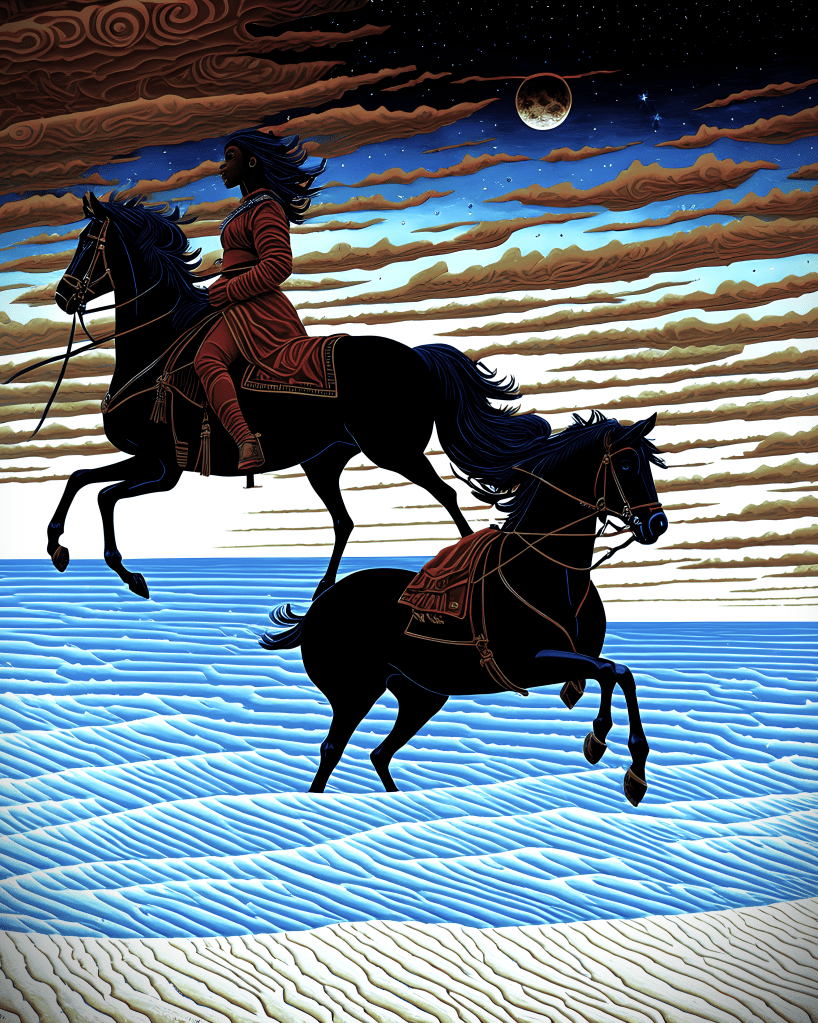
My wild stallion, fire in your eyes,
Run free, under the starry skies,
Leave behind the confines of man,
let the wind carry you as only it can.
So run, my wild stallion, run free,
allow your spirit to soar with glee,
for in your wild, a beauty so rare,
it fills the heart with inspirational flare.
Untangle your harness, let it go,
let your spirit take control,
Every stride, your heart beats strong,
A testament to where you belong.
Run, my wild stallion, run,
The moon and stars will guide you home,
The wind will carry you across the land,
until you feel freedom at your command.
Untangle your reins, let them fall,
feel the freedom, hear the call,
Of the wild that’s deep inside,
Let it burst forth, and let it ride.
So run, my wild stallion, run,
Into the night, under moon and sun,
wind in your mane, freedom in your soul,
find your way, make yourself whole.
Your midnight mane in the breeze,
Symbol of freedom that none can seize,
Across the plains, your spirit soars,
Break the shackles, open new doors
Run wild, my midnight stallion, run free,
Across the plains, let your spirit be,
Leave behind shackles that bind,
let the wind carry you, unconfined.
No Master to hold you back,
No reins to pull you off track,
Only the night and the moon to guide,
As you match the wind, stride for stride.
So run, my wild stallion, run,
Earth beneath you, the wind in your lung,
With each beat of your heart, let freedom ring,
Embrace the wild, and all it can bring.
My midnight stallion, with heart so wild,
Running, like an untamed child,
In this moment, you’re pure and free,
A symbol of what life should be.
So run, my wild stallion, run free,
And in your wildness, I too can see,
A life unbridled, a heart unclaimed,
And a spirit that can never be tamed.
My wild stallion, your life’s a dream,
Running free, like a wild stream,
In you, I see what I aspire,
A spirit unbroken, a heart on fire.
David Alexander-Ian Salie

 WoPoLi
Leave a comment