
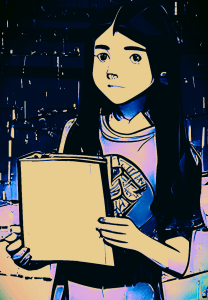
Sarah sat in her usual spot in the classroom, her mind drifting away from the teacher’s lecture. She gazed at the faces of her classmates, once familiar to her, but now appearing blank and distant. As she glanced around, she couldn’t help but see the room as a collection of lifeless objects.
The teacher’s voice echoed in the background as she announced a writing prompt. “Write anything you like in the next 20 minutes, and we’ll have volunteers share their pieces with the class.” The prompt gave Sarah a moment of excitement amidst the monotony of the day.
Feeling a surge of inspiration, Sarah eagerly grabbed her notebook and pen. Her mind was filled with a torrent of thoughts and emotions, and she found herself comparing the students to inanimate objects in the room—faceless masks, expressionless statues, and empty vessels. She began to write, pouring her soul onto the pages.
“I am sitting in a room full of people. In my thoughts, I am alone,” she wrote, capturing the essence of her current experience. She continued, “I am looking up at a blank projection screen as I sit in the corner. Beneath the screen is a container of trash on the verge of overflowing.”
As her pen danced across the paper, she felt a sense of catharsis, expressing the isolation and disconnection she had been feeling for so long. Sarah delved deeper into her analogy, drawing parallels between the world and the lifeless objects surrounding her.
“The world itself is a blank colorless screen, emotionless and cold,” she penned. “And if you look beneath its screen, all you find is a container overflowing with trash.”
Time seemed to fly as Sarah immersed herself in her writing. When the 20 minutes were up, the teacher called on people to share their work.
Sarah felt a mixture of relief and anxiety when people were called on and when they finished before the end of class, leaving time for another name to be called. She knew her words would not be easily understood by her classmates, but she couldn’t suppress the thoughts and emotions swirling inside her when given the opportunity to write. When the teacher called her name, she took a deep breath and stood up, clutching her notebook tightly.
As she stood in front of the class, she took another deep breath and began reading her piece. The room fell silent, and she could feel the weight of the words hanging in the air.
Sarah began, her voice trembling slightly. The atmosphere in the classroom grew tense. Sarah’s words were not what her peers had expected. uncomfortable glances were exchanged among the other students. They couldn’t grasp the meaning behind her metaphorical description.
A few students scoffed, others rolled their eyes, unable to relate to the profoundness Sarah was trying to convey. But she pressed on, knowing that her truth was something she couldn’t keep hidden any longer.
As Sarah reached the heart of her writing, a few curious eyes began to glance her way.
“However, if you happen to look even closer and off to the corner a little, you might find something special, not blank, emotionless, or cold. Not trashy but special, different.”
She spoke with a conviction that surprised even herself, “There are others with me. Creatures of color, emotion, and warmth. Those people might clean up the trash if it were not more populous than they were. They might fill the screen with love and truth if it were not draped so tightly, suffocating them.”
Her words hung in the air, and silence engulfed the room for a moment. Sarah could feel the weight of her emotions pressing down upon her, but she refused to be silenced. She wanted her voice to be heard, even if it meant standing alone.
“I do not know all their names or how few they are. With so much trash and blank faces, even with love right beside me, I feel utterly alone,” she continued, her voice now steadier.
“I am being buried by the trash of people’s minds. Suffocated by their unemotional existence. There is death in their zombie-like stares. I wish I could say they weren’t real, but they are. Truly as dead as the projection screen and overflowing trash container.”
The room was now abuzz with murmurs and whispers. Some students were bewildered, unable to comprehend the depth of Sarah’s words, while others were becoming more hostile, not liking what they were hearing.
“It saddens me to think they were once alive, as the screen and trash once lived,” Sarah went on. “Blossoming and budding as trees full of life until they were cut down and forced into a mold. Forced to be unnatural as they were never meant to be, as too many people have been.”
Her words seemed to challenge the very fabric of the world her classmates had come to accept. Sarah’s heart pounded as she reached the conclusion of her piece, the raw emotion in her words now apparent to everyone present.
“I struggle myself to resist the bloody ax of those living dead things who would mold me into nothingness. I will not be a blank screen waiting to be projected upon. I will not be as the discarded trash that this world has been built upon,” she declared firmly.
“You who pretend to live, you are nothing. You know no love. Or are you special? Do you hear the world screaming, feel it tremor as it suffocates under the trash of dead minds? Are you different, like the one in the corner?”
The room fell silent once more, as Sarah’s words lingered in the air, challenging her peers to confront the truths she had bared. As she reached the end, Sarah feared that instead of the understanding she longed for, she would be met with anger and confusion. Some remained closed off, unwilling to open their minds to the perspective she offered. But in the depths of a few souls, something began to stir, though unseen by Sarah—a spark of recognition that perhaps there was more to the world than they had previously perceived.
Sarah put the paper on the teachers desk and returned to her seat, feeling a mix of vulnerability and strength. She had spoken her truth, even if it had made others uncomfortable. And for the first time in a long while, she didn’t feel entirely alone because she knew she had spoken for the “creatures of color, emotion, and warmth” that she believed existed, hidden in the corners of a world that often overlooked their existence.
The other children didn’t understand her perspective, and their reactions only served to reinforce her feelings of alienation. They couldn’t grasp the depth of her emotions or the truth behind her words. They saw her as strange, different, and unrelatable.
Throughout the day, whispers and glances followed Sarah, and she felt even more isolated than before. She knew they would never truly understand her, and the knowledge weighed heavily on her heart.
The following day the teacher returned everyone’s writings with written feedback. Sarah read what her teacher had to say,
“I understand the feeling of being alone in a crowded room. It is a difficult feeling to shake, but remember that there are others out there who are also searching for connection and meaning. It is easy to feel overwhelmed by the negativity and emptiness of the world, but it is important to focus on the small pockets of love and beauty that exist within it.
It takes strength to resist the pressure to conform and to choose to live authentically. You are not alone in this struggle, and there are others out there who are fighting to stay true to themselves as well. Keep searching for the special and different creatures of color, emotion, and warmth, and try to cultivate those relationships. And remember, even the smallest act of kindness or love can make a difference in the world”
Sarah decided to rewrite the short creative essay into a poem.
In a room full of people, I sit alone,
Thoughts swirling, emotions my own.
Up at a screen, blank and stark,
In the corner, I find my own small mark.
Beneath the screen, trash overflows,
A mirror of the world it shows.
Colorless, emotionless, and cold,
The world’s story, often untold.
In the corner exists a glimmer of light,
Creatures of color, warmth, and might.
They desire to clean the trash away,
But it thrives, keeping them at bay.
Love and truth they seek to share,
But the weight of trash is hard to bear.
Amidst the faces blank and tight,
Love’s essence struggles to ignite.
Though they’re there, I feel alone,
Buried by dull minds thickets overgrown.
Suffocated by their zombie-like stare,
Aching to break free from the snare.
These living dead, once alive,
Now molded paper, unable to thrive.
Like trees cut down, their spirits bound,
By a world that strikes them to the ground.
I resist the ax, the blade so cruel,
Refusing to be shaped like a fool.
No blank screen, waiting for projection,
No discarded trash, a false reflection.
I’ll be the one who stands apart,
With colors blooming in my heart.
Feeling the world’s pain and despair,
I’ll dare to show that I truly care.
To those who pretend to live,
Who takes but never truly give,
I ask, are you special, can you see,
The world’s suffering and misery?
Or are you blind to the cries and screams,
Lost in a world of shallow dreams?
I’ll be different, like the one in the corner,
With love and truth, my spirit is warmer.
In a room full of people, I may be,
But I’ll hold fast to what sets me free.
For in the darkness, my light will shine,
A beacon of hope, a love divine.
In the midst of her loneliness, Sarah found solace in her writing. It was her refuge, a place where she could express herself freely, even if it meant being misunderstood by others. She realized that her words held power—the power to connect with those who might feel the same way and the power to challenge the perspectives of those who were unwilling to see beyond the surface.
And so, Sarah continued to write, to pour her soul onto paper, knowing that even if the world around her remained blank and uncomprehending, her words would carry her truth and her essence, giving her a sense of purpose and fulfillment amidst the sea of empty faces. She had found her voice, and she would never let it be silenced again.

 WoPoLi
Leave a comment