

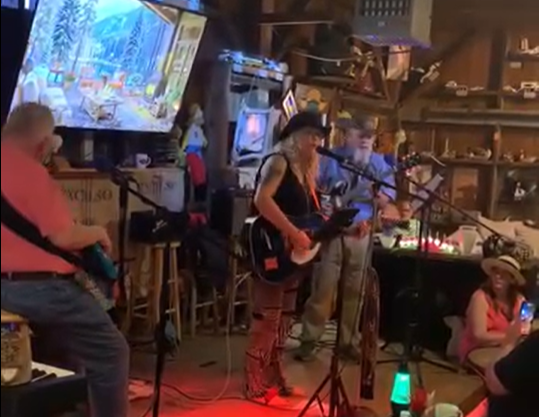
I loved listening to Brent, and Barry from Good Time Country and his daughter, guest country singer Tammy J. I love Mister Chris’ Coffee Depot and Gallery. It is a cultural treasure. What does a Train Depot in Frostproof, Florida, have to do with a painting by the famous cubist, Antonin Pelk? Just me.
In the dim light of my basement hangs an ugly painting—its frame scarred, its canvas dulled by time and dust. It came from a basement, fitting it stay in a basement. It was given to us as payment for the cleaning of a very old apartment complex. It was good that we accepted it, ugly as it was, or it would have burned in that broken down building shortly after we left the care of it.
The work bears the signature “Pelk,” a near-miss of Antonín Pelc—later renowned as a Czech cubist master. Born in 1895, Pelc trained at the Prague Academy from 1913 to 1919 and, like many avant-garde artists of his era, absorbed the influence of French cubism before moving into expressive landscapes and still lifes in the 1930s. Yet this particular piece predates his cubist phase. Created during his exile in New York under the pseudonym “Peel,” Pelc initially produced more descriptive, realistic drawings to meet American tastes—drawings that gradually regained spatial depth and collage elements, much as he had explored in the late 1920s and early 1930s.
(Picture to come later)
But this painting, which he did while studying in New York, was before his cubist days. An attempt at realism. A very bad attempt at landscape. The unattractive flat dog a hint at his destined genre. What hangs before me is a crude landscape: muddy greens stretch into a flat horizon, punctuated by this single, awkward dog—its body a stencil of ineptitude. There is no atmospheric depth, no playful dismantling of form—only earnest but unrefined realism. I reached out to a museum devoted to Pelc’s celebrated cubist and caricature works, hoping they might treasure this forgotten fragment. They declined, deeming it neither characteristic nor significant. So it remains here—a testament to the artist’s early experiments rather than his polished legacy.
It is for me, the love of ugly early works of artists, writers and the creative like. Oh how we seek the refined art and polished word. WoPoLi is not about that. It is about raw, real and experimental. This basement relic embodies this conviction I hold dear: the value of raw, early works. Just as writers draft awkward first lines and poets compose stuttering verses, artists learn through missteps. We often chase refinement—the perfect brushstroke, the seamless stanza—but it is in the unvarnished attempts that creativity truly sparks. The movement, WoPoLi, celebrates these beginnings: the unfiltered, the rough-hewn, the experimental.
If my poems never grace a stage or a best-seller list, if none is read at a presidential inauguration, if my books languish undiscovered on a dusty shelf and are found, years from now in someones forgotten library, or if one sits on the table in an old train depot coffee shop, that’s OK with me. I have accomplished greatness! I am content. Greatness resides not in applause but in the courage to create, to explore, to evolve. In embracing that flawed painting—rescued from oblivion and hanging in my basement—I claim a kinship with every artist’s first, imperfect step or their last country song after a life time of celebration. That, to me, is triumph enough.
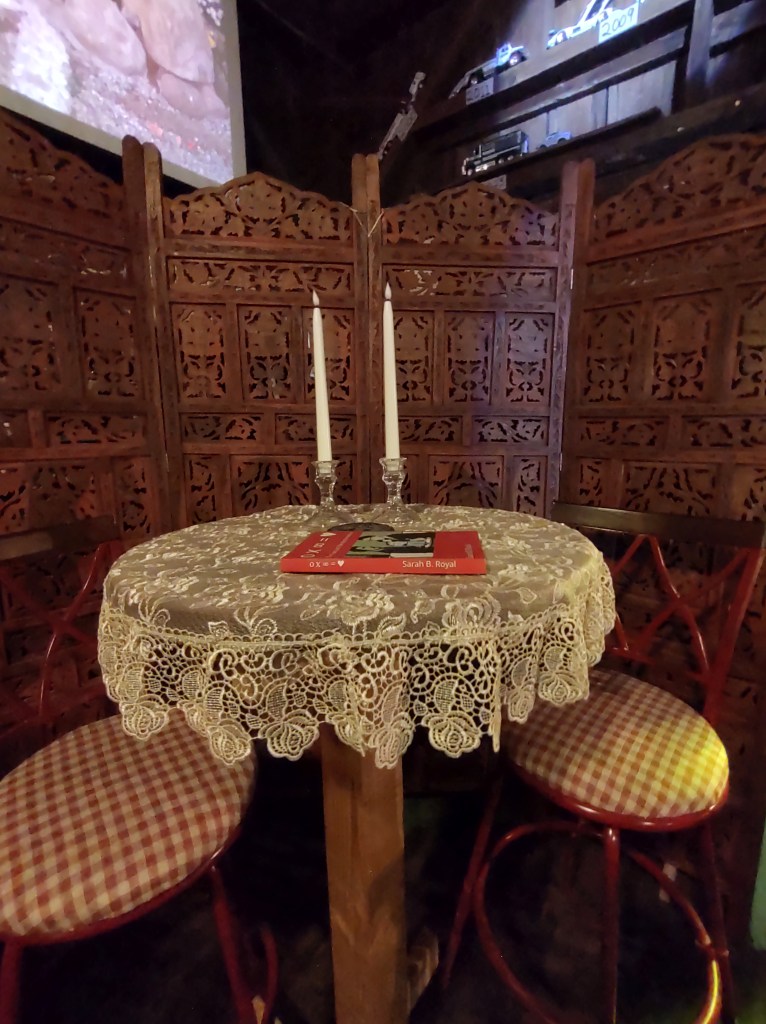
I’ve enjoyed the show a few times. Me in my hat!


 WoPoLi
Leave a comment