
Axiom Xyloid
AXiom
Y
L
O
I
D
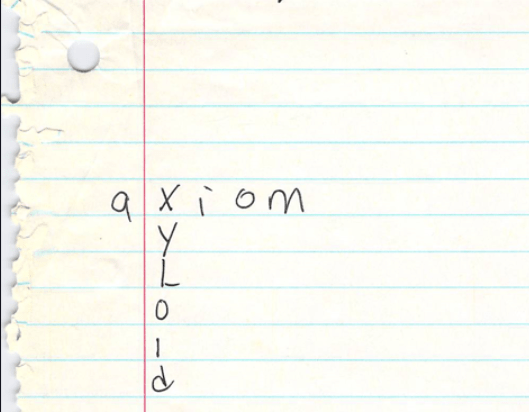
(Original written in the early 30’s and expanded upon in the early 50’s)
AXiom marks the seed, unseen yet sure,
Yearns for the sun as it bends
Limbs that reach where light stirs.
Oaths it recites while branches extend.
In each root, the law endures.
Dawn gives life—truth does not end
The poem “Axiom Xyloid” intertwines philosophical truth and natural imagery to create a meditation on endurance, growth, and the organic nature of wisdom. Through its structural constraint and thematic cohesion, the poem transforms an abstract idea—an axiom, a self-evident truth—into something living and breathing: a young tree. The “xyloid” quality, meaning “wood-like,” becomes both form and metaphor, as the poem roots logic in life itself.
Formally, “Axiom Xyloid” operates within a constraint that mirrors its meaning. The word “Axiom” serves as the title and conceptual seed, while each subsequent line begins with the letters of “YLOID” arranged vertically under the “X” in Axiom. This structure mimics the pattern of growth: the word becomes a trunk, and the lines—each beginning with a letter from “yloid”—In the second poem the developed theme branches outward in linguistic foliage and roots. The constraint, therefore, is not a limitation but a natural law, echoing the poem’s own assertion that “in each root, the law endures.” The form enacts the principle it describes that truth, like a tree, grows within structures that evolve and give it strength.
Thematically, the poem draws a subtle parallel between moral or philosophical axioms and the cycles of the natural world. The phrase, “Yearns for the sun as it bends,” personifies the axiom (the seed) as something not static but striving—seeking light, stretching beyond itself. This yearning challenges the traditional view of an axiom as fixed; instead, truth becomes dynamic, responsive, and alive. The “limbs that reach where light stirs” suggests an expansion into the light, where thought meets truth. Light brings revelation and becomes the fertile ground from which understanding grows.
“Oaths it recites while branches extend” evokes a ritual quality, as though the tree itself participates in a covenant with creation. Here, the repetition of natural cycles mirrors human devotion: the oath to grow, to reach, to endure. When the poem declares, “In each root, the law endures,” it fuses moral law and natural law into one living continuum. Truth is not written in stone but inscribed in the living body of the earth.
The closing line, “Dawn gives life—truth does not end,” completes the poem’s arc with quiet transcendence. Dawn, symbol of renewal and illumination, reaffirms that axioms—like seeds of life—are not static decrees but continuous awakenings. The final phrase resists closure, suggesting that even in death or decay, life persists in new forms, just as truth adapts and regenerates through time.
“Axiom Xyloid” is a philosophical statement and ecological metaphor. Its constraint mirrors its message: order enables growth, and structure gives life to meaning. The poem pair invites readers to see truth not as a cold proposition, but as a living principle—rooted, reaching, and resilient. Like a tree yearning toward light, the poem reminds us that enduring truths are those capable of growth and change.

 WoPoLi
Leave a comment