
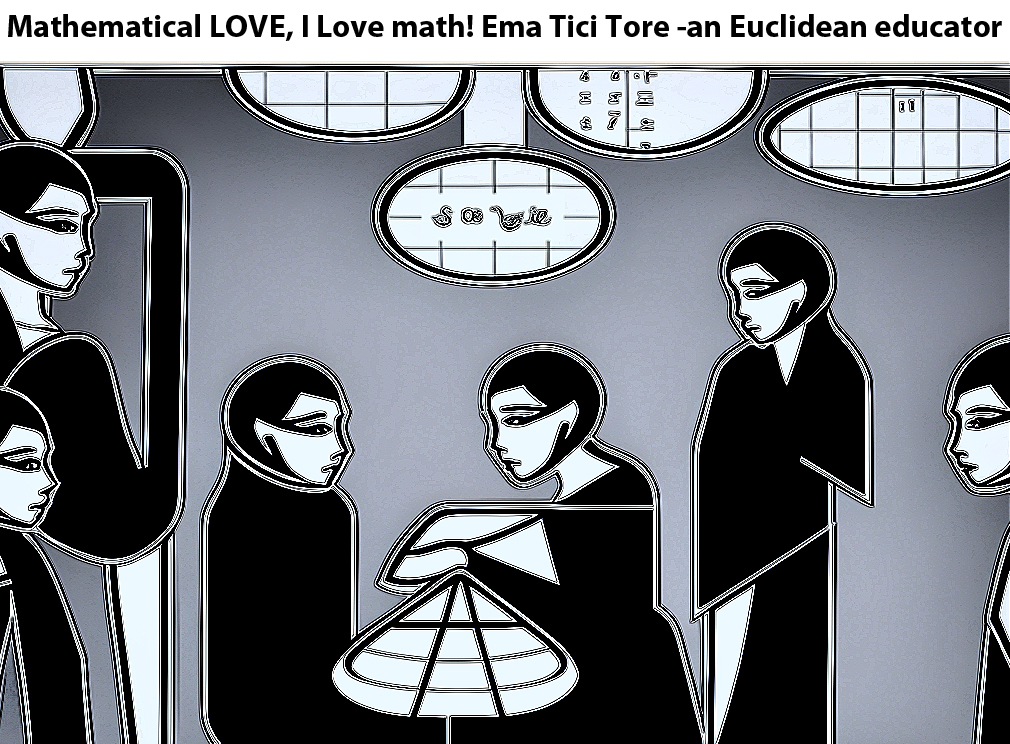
Mathematical LOVE, I Love math! Ema Tici Tore -an Euclidean educator
“I love math!” These three simple words have inspired centuries of discovery, invention, and even art. But for some, the phrase means more than admiration for equations—it is a declaration of creative affection, where mathematics and language intertwine to form something wholly new. Such is the case in Mathematical LOVE, a work of constraint literature that embodies both emotional expression and mathematical precision. The poet behind this innovation introduces a fascinating linguistic structure where every letter is used exactly twice, resulting in a perfect equilibrium between repetition and restraint—a balance that mirrors the harmony of mathematics itself.
At the heart of this creative equation stands Ema Tici Tore, described as “an Euclidean educator.” The name itself, as the poem reveals, is an anagram—a rearrangement of the same letters to produce a second meaningful phrase. This duality between base and product, between the original and its transformation, lies at the foundation of mathematical beauty. Just as geometry transforms a set of axioms into infinite forms, this poem transforms a finite alphabet into infinite possibility.
The constraint—where every letter must appear exactly twice—creates a self-contained linguistic universe, much like the closed system of Euclidean geometry. Within it, symmetry reigns supreme. The word Mathematical can be written twice without reusing any letters, forming the perfect pair. Likewise, Educator obeys the same rule. Each letter is both constant and variable, echoing the mathematician’s dual pursuit of stability and change. Every repetition becomes a reflection, like the mirrored lines of a geometric proof.
This form of writing might be called anagrammatic dual constraint, where base and product coexist in a state of mirrored order. The constraint requires intense precision: one cannot add, remove, or rearrange letters arbitrarily without breaking the structure. Yet within this restriction, the author finds room for play—for love, even. It’s not just mathematics of numbers but mathematics of letters, of patterns, of meaning itself.
In this poem, love for mathematics becomes literal. Mathematical LOVE is not just about affection for numbers; it is an act of mathematics. Each word, each letter pairing, each repetition is calculated, just as a theorem is proven line by line. It fuses emotion and logic, the heart and the mind. The title’s juxtaposition of Mathematical and LOVE bridges two worlds often considered opposites—reason and passion—and proves that both can exist in perfect harmony through artful constraint.
This union of mathematics and literature continues the long tradition of thinkers who saw the poetic beauty in numbers—Euclid, Fibonacci, and Pythagoras among them. Yet, unlike traditional mathematical proofs, Mathematical LOVE does not seek to solve a problem. Instead, it celebrates the act of creation itself—the joy of finding order in chaos, of discovering that letters, like numbers, can form infinite symmetrical relationships.
Through the persona of Ema Tici Tore, the “Euclidean educator,” the poem becomes a lesson in precision and affection. The educator is not merely teaching geometry but demonstrating how the logic of mathematics can reveal deeper truths about beauty and connection. The structure of the poem teaches discipline; its message teaches joy. Each repeated letter serves as a reminder that perfection need not be cold—it can be filled with warmth, emotion, and play.
In the end, Mathematical LOVE is both proof and poem. It shows that constraint is not limitation but liberation, that repetition can yield revelation, and that mathematics—when seen through the eyes of love—is not only a study of form but a celebration of harmony.
The Euclidean educator whispers through every line: in mathematics, as in love, beauty lies not in freedom from rules, but in the elegance of following them perfectly.

 WoPoLi
Leave a comment