
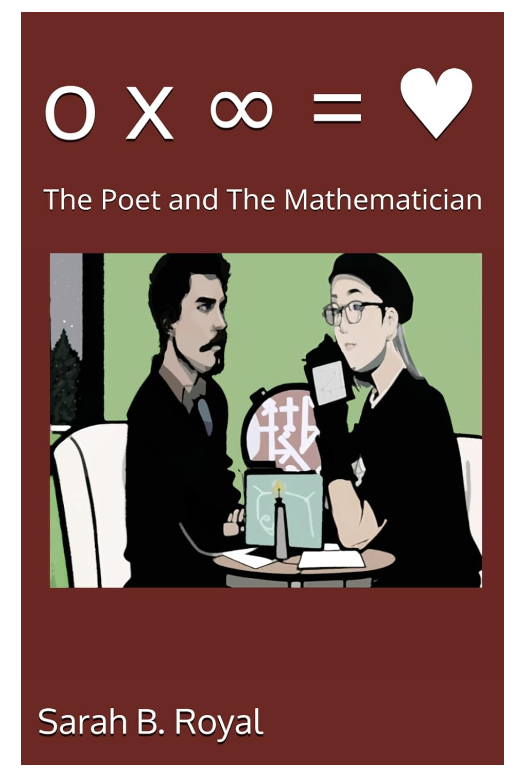
“Minute Minute” poetry is a constraint-based poetic technique developed and explored by Sarah B. Royal in her book The Poet and The Mathematician. This form plays with homographs—words that are spelled the same but pronounced differently—and uses semantic ambiguity and phonetic constraints to create layered meanings that shift depending on how the poem is read aloud. At its core, “Minute Minute” poetry revolves around the dual pronunciation of the word minute: MIN-it, a unit of time, and my-NOOT, meaning extremely small. By repeating and recontextualizing the word, the poem forces the reader to choose a pronunciation, which in turn alters the meaning of each line. This constraint functions as a linguistic puzzle, where sound and sense are deeply interdependent.
The form is characterized by phonetic ambiguity, where words with multiple pronunciations create tension between visual and auditory interpretation. It also relies on semantic layering, as each line may carry several meanings depending on how the key word is spoken. Many lines incorporate mathematical or philosophical logic, using recursive phrasing, inversion, and abstract reasoning to mirror mathematical proofs and contemplative inquiry. Central to the technique is temporal meditation: the measurement, perception, and distortion of time serve as both the thematic and structural backbone of the poem.
For example, the opening line of Royal’s poem, “Minute is moments in time in Moment’s ‘is’ Minute,” sets the tone by presenting minute twice, inviting readers to consider both senses: are time and experience composed of discrete measured units (MIN-it) or infinitesimal fragments (my-NOOT)? Later, lines like “Am I minute time? Minute I am!” play with identity and scale, suggesting embodiment of time or smallness, depending on pronunciation. Recursive lines such as “Mathematically speaking, time is time speaking mathematically” reflect the poem’s structural constraint, looping language back on itself in a way reminiscent of mathematical proofs.
“Minute Minute” poetry matters because it challenges readers to engage with language as sound, symbol, and concept simultaneously. It encourages active reading and vocal experimentation, blurs the line between poetry and logic, and adapts the OuLiPo tradition of constraint-based writing into Royal’s own WoPoLian style. In this form, meaning is not fixed but can shift with breath, pronunciation, and attention, demonstrating that poetry can exist as a living interplay of sound, thought, and interpretation.
Minute Minute
Sarah B. Royal (age 20)
Minute is moments in time in Moment’s “is” Minute.
To frame time in “Minute” is minute in time frame too.
I hold time in minutes in time. Hold I
the numbers of hours. Pass by. Pass hours of numbers. The
mediocrity! In times of contemplation of times in mediocrity,
minutes become hours and days and hours become minutes.
Remember? Too many times when I am full, wonder I,
“Wonderful am I when time’s many to remember.”
Mathematically speaking, time is time speaking mathematically.
Yet, two hours times four equals the eight only if minutes,
if only, ate the equals, for time’s ours too, Yet…
However I am, ask me. Ask, am I ever? How?
Am I minute time? Minute I am!
Contemplate contemplation. Contemplate!
Wait. I, if time I am not, am I time if I wait?

 WoPoLi
Leave a comment