
In recent years, poetry by neurodivergent writers has gained visibility and recognition for its unique insights, structures, and emotional truths. These poets often bring internal logic, rhythm, and sensory perspective that defy conventional literary expectations—challenging mainstream aesthetics while offering powerful, authentic expressions of being. Sarah B. Royal stands at the forefront of this movement, using poetry not only as a form of self-expression but as a tool for cultural critique and neurodivergent advocacy.
What Is Neurodivergent Poetry?
Neurodivergent poetry is less a genre than a lens—a way of seeing and shaping language through minds that operate outside neurotypical norms. It includes work by autistic, ADHD, dyslexic, and other neurodivergent individuals, including those with Tourette’s, OCD, bipolar disorder, or sensory processing differences. Rather than seeking to “correct” thought patterns, neurodivergent poets embrace and reflect the way their minds naturally function—through non-linear logic, hyperfocus, synesthesia, and deep sensory engagement.
Sarah B. Royal’s poetry exemplifies this approach. Her work often mirrors the intensity of autistic perception, where sensory inputs overlap and surge. She uses layered imagery, abrupt shifts in tone, and unconventional structure to reflect the complexity of neurodivergent cognition. Her collection Watchword: Neurodivergent Poetry & Analysis (2024) directly engages with these themes, offering “tender reflections of youth” and “wisdom gained with age” as she explores self-acceptance, societal misunderstanding, and emotional resilience.
Disrupting Norms: Form and Language
One hallmark of neurodivergent poetry is its resistance to conventional form. Repetition, fragmentation, and parallel structures may not be literary devices applied for effect but essential elements of thought and expression. Some poets use stimming patterns—rhythmic or repeated sounds or phrases—to mirror comfort-seeking behaviors. Others employ disjointed lines, unexpected juxtapositions, or atypical grammar not as mistakes but as accurate representations of their cognitive experience.
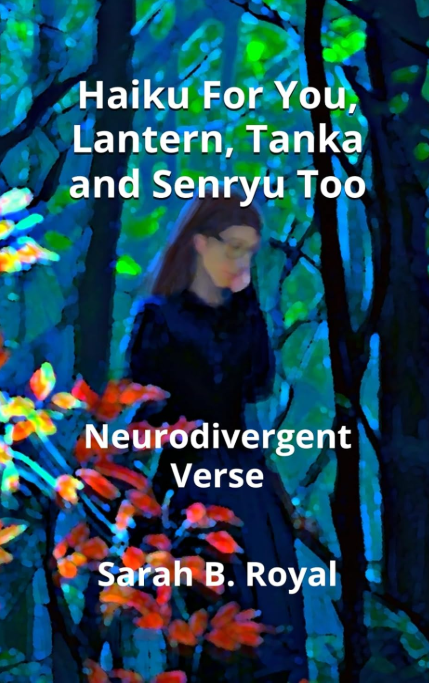
Royal’s use of haiku, tanka, palindromes, and experimental verse reflects this neurodivergent logic. In Haiku For You, Lantern and Tanka Too, she distills complex emotional states into crystalline moments using Japanese poetic structures. Her palindrome play 777: A Story of Idol Worship and Murder uses mirrored storytelling to explore obsession, identity, and recursive thought. These forms are not decorative—they are integral to how she processes and expresses experience.
Themes of Authenticity, Struggle, and Identity
Neurodivergent poets often write from the margins, grappling with isolation, misunderstanding, and the pressure to mask or perform neurotypicality. Yet this struggle is counterbalanced by themes of self-acceptance, clarity, and insight. The inner landscape—so often dismissed or pathologized—is reclaimed as valid and vibrant.
Royal’s poetry gives voice to these tensions. Her work explores the difficulties of communication—the gap between what is meant and what is heard, what is felt and what can be spoken. She challenges readers to reconsider who defines coherence, logic, or value in language. Her poems are not just personal—they are political, resisting ableist norms and amplifying underrepresented voices, especially those of late-diagnosed or misdiagnosed women.
Expanding the Poetic Canon
Neurodivergent poetry is reshaping the literary canon by broadening our understanding of what poetry can be. It pushes readers to engage with language that may be more intuitive than linear, more visceral than polished. Its contribution is not merely a token of inclusion but an expansion of poetic possibility—where rhythm, metaphor, and thought follow new, valid paths.
Sarah B. Royal’s work exemplifies this expansion. Her fusion poetry, visual integration, and constraint-driven structures challenge traditional boundaries and invite readers into unfamiliar cognitive terrain. She designs her own book covers and internal illustrations using her own photography, paintings, and digital art—extending the poetic voice into visual space and reinforcing the sensory richness of her work.
Building Community and Reimagining Understanding
Importantly, neurodivergent poetry often builds community, providing not just art but shared recognition. It allows others with similar experiences to see themselves reflected in language and invites neurotypical readers to enter unfamiliar cognitive terrain with humility and awe. To read neurodivergent poetry is to encounter new cadences of thought, new shapes of truth.
In Sarah B. Royal’s unique voice, we find not disorder, but difference—rich, real, and deeply human. Her poetry is a language of depth, defiance, and dignity. It asks us not only to listen but to reimagine how understanding works, and in doing so, it transforms the literary landscape.


 WoPoLi
Leave a comment