
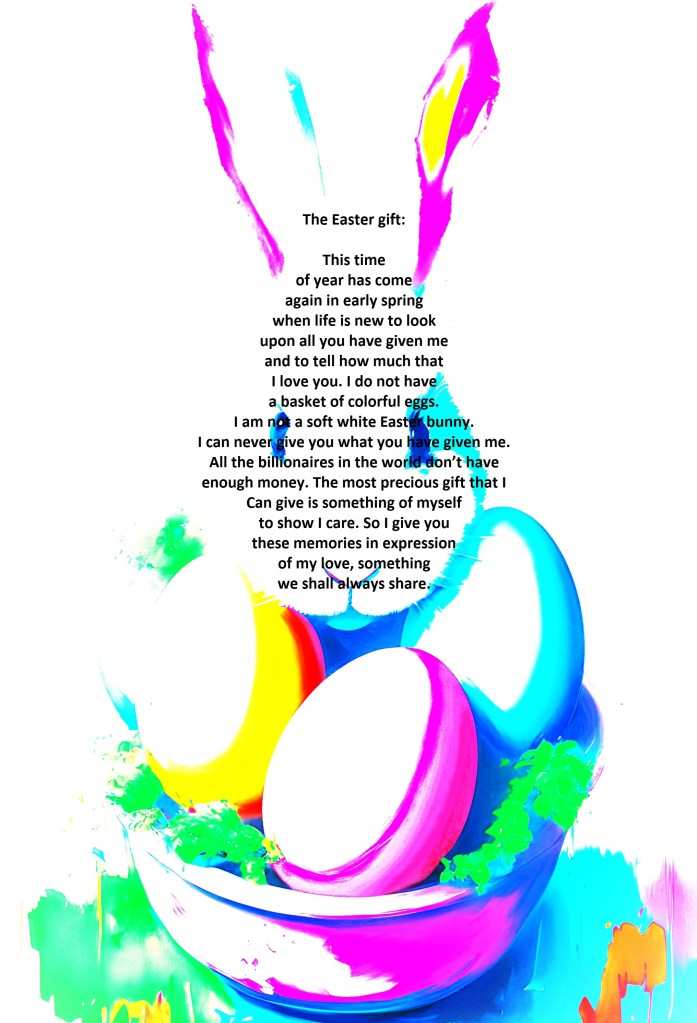
Concrete poetry, also called visual poetry, is a form in which the visual arrangement of words on the page is as important as their literal meaning. Rather than relying solely on traditional poetic devices such as rhythm, rhyme, or metaphor, concrete poems use typography, spacing, and shape to create a visual experience that reinforces or enhances the poem’s theme. The layout of the words often forms images, patterns, or symbolic structures that are integral to the poem’s message, making the shape inseparable from the content. Spatial constraints such as line length, indentation, and pacing are deliberately used to sculpt the poem, allowing readers to engage with it both as text and as visual art.
For example, Sarah B. Royal’s poem An Easter Gift, written at age fifteen, is shaped like an Easter basket, reflecting the themes of seasonal renewal, gratitude, and personal offering. The poem’s tapering lines mimic the curved form of a basket, visually suggesting containment and giving. Lines such as “All the billionaires in the world don’t have enough money” create striking contrasts, emphasizing that material wealth cannot match emotional generosity. Interestingly, at the time, the word “billionaire” was rare, yet Royal used it to make an extreme point—anticipating language that would later become commonplace. The poem concludes with lines that close the basket, offering the poem itself as a gift: “So I give you these memories in expression of my love, something we shall always share.” Here, the form and sentiment are inseparable, creating a tangible emotional artifact.
Concrete poetry also intersects with mathematical precision. As Royal notes, “A poet CAN write like a mathematician!” The structure, symmetry, and spatial logic of concrete poems mirror mathematical thinking, much like Lewis Carroll’s “mouse’s tail” poem in Alice’s Adventures in Wonderland, where the poem’s shape directly reflects its subject. In this way, concrete poetry bridges literary art and visual design, emotion and geometry, inviting readers to see language not merely as a vehicle for meaning, but as a medium for shape, rhythm, and presence. Royal’s An Easter Gift, along with Carroll’s example, demonstrates how words can be both read and viewed, creating an experience that is simultaneously intellectual, emotional, and visual.
The Easter Gift
This time
of year has come
again in early spring
when life is new to look
upon all you have given me
and to tell how much that
I love you. I do not have
a basket of colorful eggs.
I am not a soft white Easter bunny.
I can never give you what you have given me.
All the billionaires in the world don’t have
enough money. The most precious gift that I
Can give is something of myself
to show I care. So I give you
these memories in expression
of my love, something
we shall always share.

 WoPoLi
Leave a comment