
I have a curious mind. I read definitions and compose poetry from them. So it was with the poem Lettrisme.
Lettrisme is a French avant-garde artistic and literary movement founded in Paris in the mid-1940s by Isidore Isou. It treats the letter—the smallest unit of written and spoken language—as the primary material of artistic creation, placing letters and sounds before conventional meaning.
Lettrist poetry often employs phonemes, invented words, and onomatopoeia for their sonic and visual qualities rather than for semantic content. Its focus is the aesthetic autonomy of signs: letters, symbols, and marks are treated as pure artistic elements rather than as carriers of meaning.
Influenced by Dada, Surrealism, and Futurism, Lettrisme later shaped movements such as Situationism, Fluxus, sound poetry, and experimental cinema. It is the art of letters freed from linguistic constraint—a radical reimagining of writing, sound, and symbol as raw creative material.
Lettrisme is not simply nonsense poetry. It is a theory-driven avant-garde movement that seeks to rebuild poetry from its smallest unit—the letter—and deliberately distinguishes itself from earlier or parallel forms of non-semantic writing. It rejects invented words that resemble English or rely on syntax, narrative, or semantic suggestion, because its aim is not to distort meaning but to abolish semantic expectation altogether.
Lettrist poems often contain clusters of letters that resemble words, phonetic sequences that echo Romance, Slavic, or Semitic patterns, and invented morphemes that mimic linguistic rhythm. The text may appear to be a foreign language because it uses letter clusters and phonetic sequences for their aesthetic qualities rather than for meaning.
Lettrisme also separates itself from Dada sound poetry, which often emphasizes anarchic spontaneity and anti-art performance. Instead, Lettrisme insists on a systematic theory of letters and a new aesthetic order. The letter is treated as both a visual and an acoustic unit—not merely sound, not merely nonsense, but something prior to meaning: pre-sense.
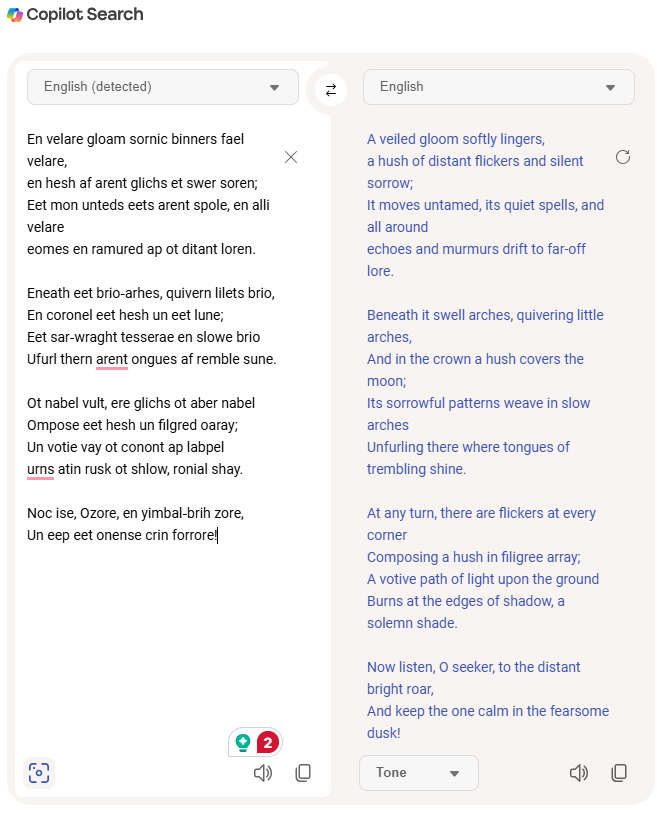
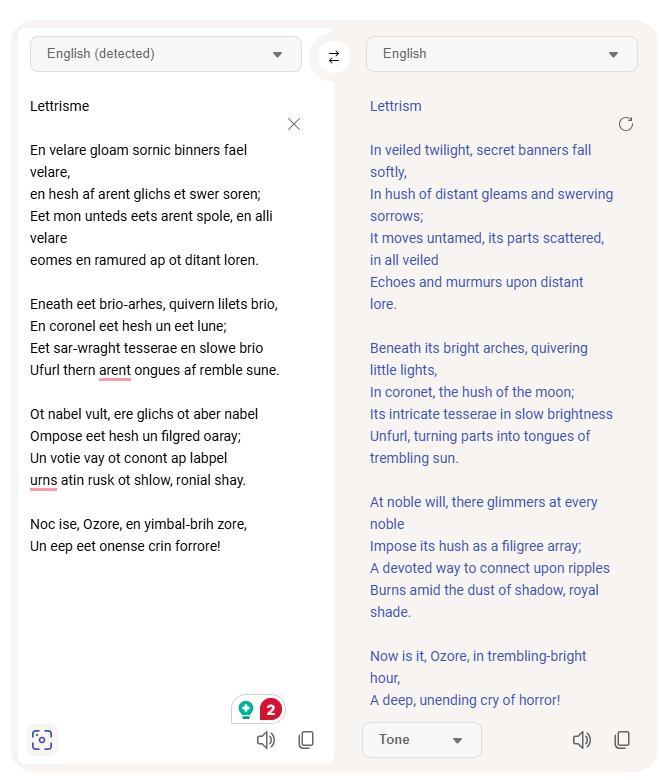
Once my Lettrisme poem was complete, a thought occurred to me. Because I had shaped the poem to resemble a conventional sonnet—mimicking the appearance of a foreign language (not required in Lettrisme, but permitted)—while ensuring it remained nonsensical, I wondered whether Google Translate might mistake it for a real language.
Google Translate detects patterns of orthography and attempts to match them to known linguistic signatures. In this experiment, I discovered that it will guess the closest language even when the text is pure invention. In this case, it assumed the language was English and attempted to “correct” what it interpreted as misspellings within the nonsense.
Below are two results. First, I copied the sonnet without its title and was surprised by the outcome. Then I added the title, thinking that maybe Google might realize that the purpose of the words were nonsensical based on the title. A similar translation emerged. From this intriguing accident, I decided to compose an actual sonnet.
Here is my polished version inspired by this surprise!
The Lettrisme of the Belletrist Translated
In the veiled gloom of twilight, secret banners fall,
While flit distant flickers thread the darkening air;
Spells all around, scatter beyond the outer wall,
Murmurs, far-off lore, fragments turning everywhere.
Beneath high arches, quivering little points of light,
A coronet encircles the trembling, waning moon;
Its intricate tesserae, mosaic in sight,
kindle tongues, tendrils of sun, that flare and fade too soon.
A noble will striking at glimmering designs,
imposes its form in a filigreed array;
A votive of fire ripples along hidden lines
As it burns through the drifting dust of dim decay.
Now, listen O seeker, within this unsteady hour,
Hear the fearsome resound, the nameless cry for power.

 WoPoLi
Leave a comment