
Concrete Poetry (the page as field)
I created a codex for Alt Poetry where Unicode and ALT function Glyphs hold meaning. It will be part of an upcoming book, but this is my first one using the Codex specifically in a visual way. I have to give credit where credit is due; I got the idea from Igor V. Satanovsky : The Щymmetry Studies. So this is my attempt at trying his techniques with my own flavor. I experimented with two other forms using his techniques. I have attempted to explain the techniques used below. I have not studied his techniques in depth, and this is only my interpretation. I dabble in techniques while his work is a deep dive. Look him up if you’re interested in learning more about his work.
Concrete poetry reconceives the page as a compositional field in which typography and spatial arrangement function as primary structural elements rather than secondary vehicles for verbal meaning. In this tradition, repetition, stacking, mirroring, and compression are not ornamental devices but generative procedures. The poem is not merely read sequentially; it is apprehended visually. Letters and clusters become spatial events. Capitalization and lowercase variation introduce dynamic contrast analogous to musical notation—forte and piano—so that orthography performs intensity rather than grammar. The poem consequently resembles a score rather than a narrative, organizing visual rhythm instead of advancing plot or argument.
Within this framework, meaning does not disappear but shifts from fixed reference to probability. As syllables are rearranged and reduced, semantics hover without stabilizing. Fragments remain grammatically suggestive, yet they resist consolidation into declarative clarity. This condition resembles linguistic superposition: possible meanings remain latent but unresolved. When mirroring, doubling, and compression are applied to letterforms, visual instability generates tension. A perfectly symmetrical glyph would produce decorative balance; a nearly symmetrical glyph produces friction, drift, and transformation. Each stage of reduction intensifies the operation, moving from phonetic permutation to glyphic abstraction. The work thus integrates phonetic recursion, typographic choreography, and probabilistic semantics, treating the consonant cluster simultaneously as a sound-object, a visual object, and a conceptual operator.
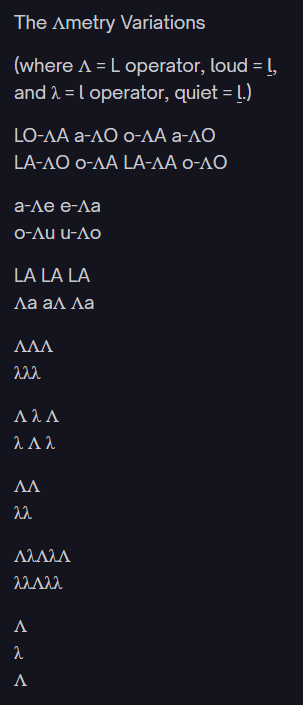
The poem entitled The Λmetry Variations operates within this concrete-poetic logic while grounding itself in English-adjacent phonotactics. It establishes a single consonantal operator—Λ/λ functioning as L—around which vowel permutations circulate. Syllables such as LO-ΛA, LA-ΛO, and a-Λe are pronounceable within English phonetic familiarity, yet they do not form English words. The poem, therefore, relies on phonotactic plausibility without invoking lexical reference. Capital and lowercase forms distinguish dynamic intensity rather than grammatical category, reinforcing the musical analogy. The procedure follows a clear trajectory: grammatical or syllabic origin, permutation through vowel rotation, reduction into repeated clusters, isolation of glyphic units, and final symmetry play through alternation and compression. As the sequence progresses, pronounceable clusters give way to abstract patterning. The result is the abstraction of sound: the stable phonetic center dissolves into a visual consonant unit. The poem collapses language downward—from syllable to letter to residual pattern—without abandoning structural coherence.
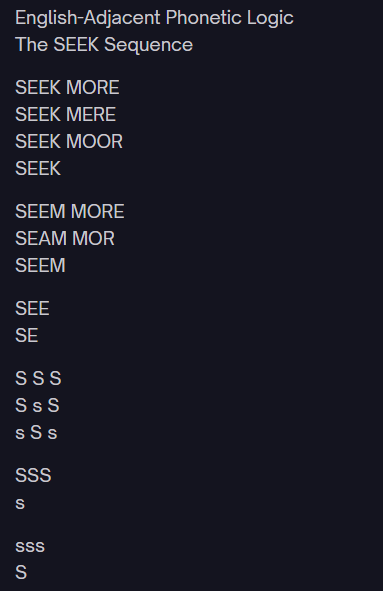
The SEEK Sequence begins from a more explicit semantic anchor. “SEEK MORE” provides recognizable English vocabulary and syntactic familiarity. Minimal vowel substitutions (MORE/MERE/MOOR), consonant trimming (SEEM/SEAM), and gradual lexical erosion transform the phrase while maintaining phonetic adjacency, particularly the long E sound. The poem remains grounded in English phonology and orthography even as meaning thins. Capital and lowercase contrast again serve as dynamic modulation rather than grammatical distinction. Unlike The Λmetry Variations, which begins without full lexical meaning, SEEK Sequence initiates with semantic clarity and performs its loss incrementally. The reader experiences semantic decay rather than semantic absence. The collapse moves from a phrase to a word fragment to an isolated consonant, eliminating lexical meaning while preserving alphabetic structure. Language again collapses downward, but here what disappears is referential meaning itself.
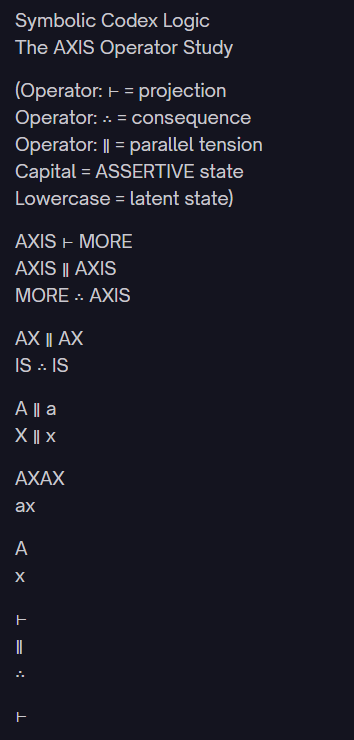
In contrast, the AXIS Operator Study exemplifies symbolic codex logic, in which symbols function as operators rather than decorative marks. Here, ⊢ signifies projection, ∴ indicates consequence, and ∥ marks parallel tension. Capitalization and lowercase differentiate ontological states—assertive versus latent—rather than phonetic intensity. The poem begins with a word-plus-operator relation (“AXIS ⊢ MORE”) and proceeds through rule-based reduction: AXIS contracts to AX, then to A and X, while operator relations persist. The sequence ultimately eliminates all lexical material, leaving only operators. This is not phonetic drift or semantic erosion but operational transformation. Meaning collapses into a structural relation. Whereas the first two poems reduce language into glyphic residue, the AXIS study abstracts language outward—from word to relation to pure operator. It performs formalization rather than entropy.
Across the three works, a comparative structure emerges. The Λmetry Variations is grounded in English-adjacent phonetic familiarity and Western alphabetic reasoning; its primary logic is sound permutation leading to phonetic abstraction and a terminal visual consonant unit. SEEK Sequence is grounded in English semantic origin and orthography; its logic is sound-based erosion resulting in semantic decay and an isolated consonant. AXIS Operator Study is grounded in symbolic codex logic and Western alphabetic operators; its logic is rule-governed operational transformation culminating in relational abstraction and pure operators.
Their trajectories clarify a fundamental distinction. Λmetry Variations and SEEK Sequence collapse language downward—from sound to letter to residue—performing entropy within alphabetic structure. AXIS Operator Study collapses language outward—from word to structural relation to operator—performing formalization. In each case, conventional subject–verb–object syntax is absent. Yet all three remain structurally logical within Western alphabetic reasoning. Meaning does not vanish arbitrarily; it is systematically transformed. The poems demonstrate that linguistic coherence can be sustained through phonetic, visual, or operational systems even when conventional semantics and syntax are removed.

 WoPoLi
Leave a comment