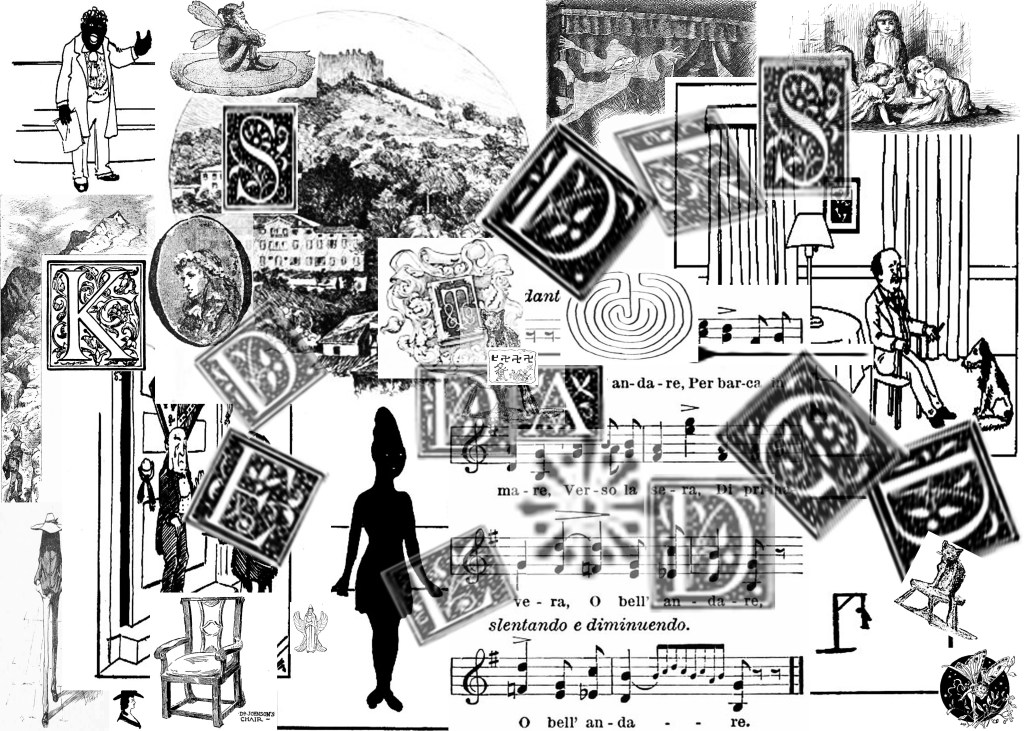
The below collage fits into the tradition of Lettrisme and Asemic Art, specifically a contemporary digital branch sometimes called Hypergraphics or Metagraphy. By repurposing public-domain imagery from Project Gutenberg, I am engaging in détournement—the act of rerouting the original intent of cultural artifacts into a new, subversive context.
This technique, known as asemic collage, transforms the functional world of literacy into a purely visual landscape. It utilizes ephemera—vintage book illustrations, ornate dropped capitals, and sheet music—not as carriers of information, but as raw textures and shapes. By layering unrelated visual symbols, I “chisel away” (the Lettrist phase ciselante) the ossified meanings of the original texts. For example, a musical score becomes a rhythmic background, while an illuminated “D” or “S” serves as a structural anchor rather than a letter. The goal is to create a “wordless open semantic form”. Because the collage is unreadable in a traditional sense, it forces the viewer to find meaning through aesthetic intuition and visual emotion rather than literal translation. In this style, I moving beyond being a reader of books to being a creator of producer-artifacts, where the “text” is meant to be felt as a sensory experience.
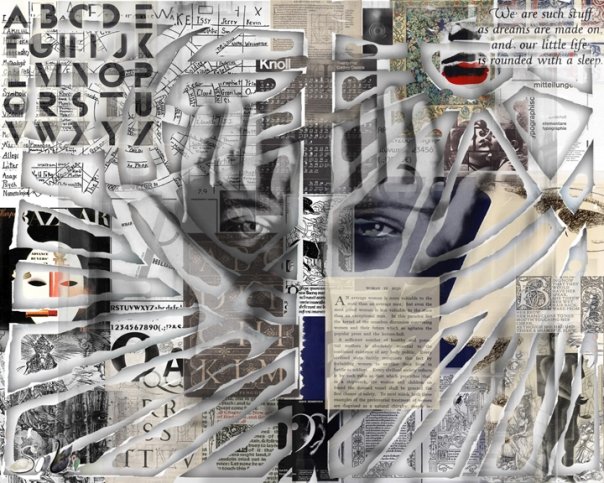
This next collage, similar to the first, is a sophisticated example of asemic collage, where typography and literary excerpts are repurposed to create a purely visual, non-semantic experience.
While the previous work used isolated figures and icons, this piece leans into the layering of text as texture to evoke a dreamlike or psychological atmosphere. It utilizes a high concentration of found text—alphabet charts, newspaper snippets, and literary quotes (like Shakespeare’s The Tempest). These elements are no longer meant to be read as a story but are treated as rhythmic patterns and graphic shapes. This piece employs metagraphy, a Lettrist technique that integrates photography and typography into a single “hypergraphic” field. The central image of hands and eyes is partially obscured by “torn” white overlays, creating a sense of depth and fragmented identity. By placing the quote “We are such stuff as dreams are made on” alongside a jumble of random letters and numbers, a visual metaphor is created for the way the mind processes information. The technique suggests that meaning is something the viewer must “dream up” or assemble from the wreckage of traditional language. This style explores “hidden journaling”—where the weight of the written word is present, but its specific message is deliberately obscured to focus on the emotional impact of the composition.

 WoPoLi
Leave a comment