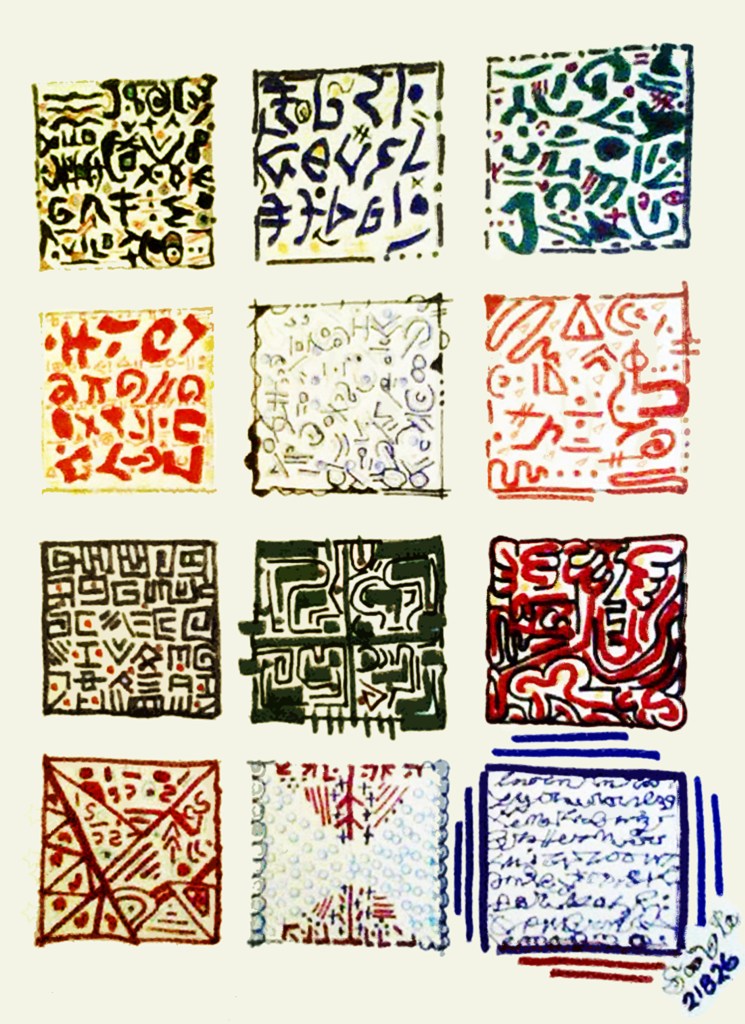
The artwork presented functions as a compelling example of asemic writing through its deliberate simulation of script without recourse to fixed semantic content. Arranged in a grid of square panels, the composition mimics the structural authority of manuscript pages, illuminated codices, or archival fragments, yet each panel contains gestural marks that resist linguistic decoding. The viewer encounters strokes that resemble alphabets, calligraphic flourishes, marginalia, and diagrammatic notations, but none resolve into identifiable language. This tension between familiarity and illegibility is central to asemic practice: the marks clearly belong to the visual vocabulary of writing—lines, glyph-like figures, rhythmic repetitions, and directional strokes—yet they remain unmoored from grammar, lexicon, or syntax. The work thus exemplifies how asemic writing inhabits the threshold between text and image, inviting the cognitive reflex of reading while simultaneously suspending semantic closure.
The grid structure reinforces this dynamic by suggesting discrete “pages” or textual units, each with its own tonal and gestural character. Variations in color—earthy ochres, saturated reds, deep greens, and blues—further differentiate the panels, evoking diverse historical scripts or cultural manuscripts without directly referencing any specific system. Some squares suggest dense, compact notation reminiscent of archival documents; others emphasize sweeping, calligraphic movement, foregrounding the physicality of the hand. This emphasis on gesture and motion aligns with a core principle of asemic writing: the handwriting quality becomes the primary carrier of meaning. Pressure, speed, layering, and repetition generate rhythm and emotional tone, allowing viewers to infer mood or symbolic resonance without translating content. Meaning, therefore, is not absent but radically open, emerging through embodied perception rather than linguistic decoding.
Importantly, the marks do not operate as cipher or coded language; there is no stable key that would convert these forms into conventional words. Nor does the work rely on recognizable letters or phonetic fragments that would align it with pre-semantic or experimental alphabetic traditions. Instead, it sustains the illusion of script while refusing linguistic obligation, maintaining the autonomy of pure script-form. The final panel, which most closely resembles cursive handwriting, underscores this strategy by appearing momentarily legible before dissolving into abstraction upon closer inspection. Through this oscillation between recognition and estrangement, the artwork demonstrates how asemic writing transforms the act of writing into an aesthetic event. The viewer engages as a participant in visual symbolic rhythm, and projection with intuitive interpretation, experiencing the pleasure of textual form liberated from fixed meaning.

 WoPoLi
Leave a comment