Philosophical study in Hebrew
One To One
2+4+27=33
33+88= 121
One to One: Number, Language, and the Structure of Mind
The poems “Two Minds” and “One To One” use numbers for counting, and more so, for meaning. Together they build a system where mathematics, language, and spiritual symbolism work as one structure. The speaker in “Two Minds” claims to have “two minds to think, and four minds to dream, and twenty-seven for interpreting.” These numbers are seemingly random yet can be connected directly to the Hebrew symbolic system of letters and gematria, where every letter has a number and every number carries layered meaning. When the poem shifts into the equation “2 + 4 + 27 = 33” and then “33 + 88 = 121,” the mathematics becomes a compressed spiritual argument. The title “One To One” reflects both the number 121 and the idea of unity returning to itself.
In Hebrew symbolism, the number two corresponds to the letter Bet (ב), which means “house.” The number four corresponds to Dalet (ד), meaning “door.” The number twenty-seven represents the total letters of the Hebrew alphabet, including the five final forms. When the poem says there are “twenty-seven for interpreting,” it suggests that interpretation happens through language itself. Language is the full field of symbolic possibility. When two (house) and four (door) combine with twenty-seven (complete language), they equal thirty-three. Symbolically, the house and the door of language create a structured system through which meaning can be entered and understood.
The number thirty-three has strong biblical and mystical associations. In some traditional readings, the thirty-third mention of major biblical figures such as Noah, Abraham, and Jacob occurs at moments connected with divine promise. Noah receives the covenant that the earth will not be destroyed by flood. Abraham sees the fulfillment of the promise through the birth of Isaac. Jacob dreams of a ladder connecting heaven and earth. Because of these patterns, thirty-three is often associated with fulfillment, spiritual maturity, and hidden promise. Mathematically, thirty-three can also be seen as two threes. Since three often symbolizes wholeness or completion, doubling it intensifies that sense of fullness. In the poem’s structure, thirty-three becomes the stage of illumination: learning rising from language.
The next movement adds eighty-eight. While eighty-eight does not correspond to a single Hebrew letter, it carries symbolic interpretations. It may be read as eight plus eight. The number eight in Hebrew thought often represents new beginnings or what exists beyond natural cycles, since seven symbolizes completion within nature. Circumcision on the eighth day marks covenantal renewal. Therefore, eighty-eight can suggest renewal doubled, or expansion beyond ordinary limits. Some mystical traditions interpret eighty-eight as mirrored or cosmic reinforcement, a doubling of spiritual force. When thirty-three, the number of promise and maturation, joins with eighty-eight, the result is one hundred twenty-one.
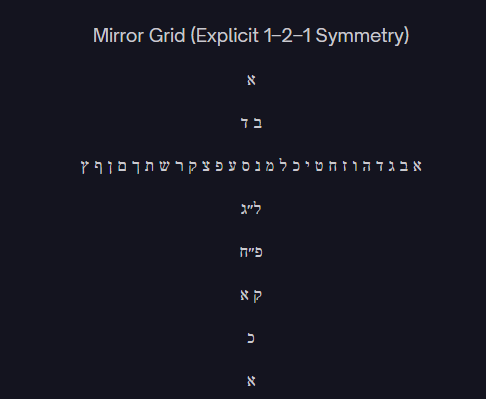
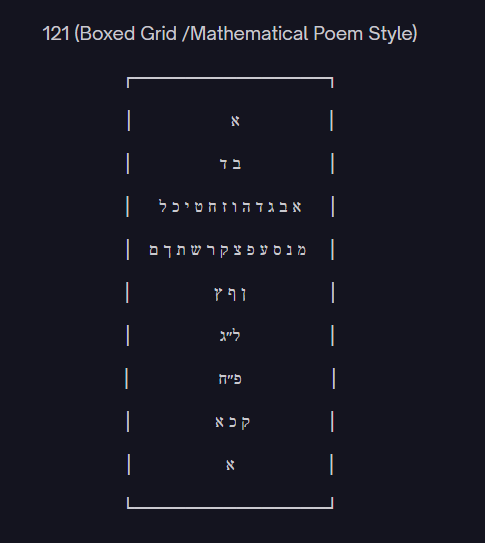
One hundred twenty-one is mathematically eleven squared. Eleven is often viewed as a number that goes beyond ten, which represents order or completeness. Because eleven moves past ten, it can symbolize transcendence, disruption, or prophetic insight. When squared, that movement beyond order becomes intensified and stabilized. In Hebrew letter values, 121 can be expressed as 100 (ק, Kuf) plus 20 (כ, Kaf) plus 1 (א, Aleph). Kuf is sometimes associated with holiness or cycles brought to completion. Kaf symbolizes the palm of the hand, suggesting potential or the ability to shape reality. Aleph represents unity and the divine source. When arranged as 1–2–1, the number visually mirrors itself. It begins with one, expands into duality, and returns to one. Unity moves outward and then comes back to unity.
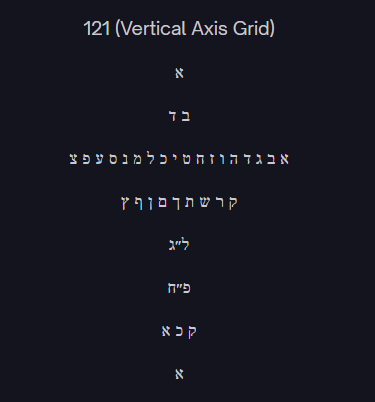
This pattern reflects the deeper structure already present in the earlier equation. Two (house) and four (door) open into twenty-seven (language). Language becomes thirty-three (promise fulfilled through structure). Promise expands through eighty-eight (cosmic doubling or renewal). The result is 121, the return to unity with greater fullness. The poem’s typographic grid, when arranged symmetrically, visually enacts this movement: a single Aleph at the top and bottom, with layers of structure in between. The mathematics becomes architecture. The numbers do not only calculate; they build.
“Two Minds” adds a psychological layer to this symbolic system. The speaker claims multiplicity—many minds, many faces—while accusing the listener of having only “half a mind.” The tension in the poem is between complexity and blindness. The speaker’s many numbers represent layered consciousness, interpretive depth, and spiritual expansion. The listener’s divided half suggests limited perception. When the poem states, “If I were anymore clear, you’d see right through me,” suggests that too much clarity removes mystery, while too little perception creates blindness. Interpretation requires full participation in language and structure.
The YouTube link is the song itself sung by the author using only voice echo for music. It was written over three decades ago and recorded almost two decades ago, and has since expanded in this study. The text when combined with voice and music has multimedia resonance, but the central meaning remains numerical and linguistic. The movement from covenant to cosmic expansion to transcendent completion parallels broader biblical and mystical themes. Some scholars compare such numerical expansions to the way the divine name is unfolded into larger numerical expressions in mystical traditions. However, this poem does not simply repeat established systems. It creates its own idiom. Instead of expanding to seventy-two, it expands to one hundred twenty-one. Instead of stopping at promise, it squares transcendence.
Ultimately, “One To One” encompass equation, poetry, theology, and musical performance. It proposes that structure leads to illumination, illumination leads to expanded speech, and expanded speech returns to unity. The house and door of language become learning and light. Elevated speech moves beyond limitation. The result is not fragmentation but restored oneness. The mirrored number 121 embodies that return. Unity goes out through mind, dream, and interpretation, and then comes back to itself. The poem demonstrates that mathematics and language are not opposites. They are two expressions of the same desire: to move from division toward wholeness, from many minds back to one.
Below are processional creations expressed in concrete poetic forms and additional poetic texts.
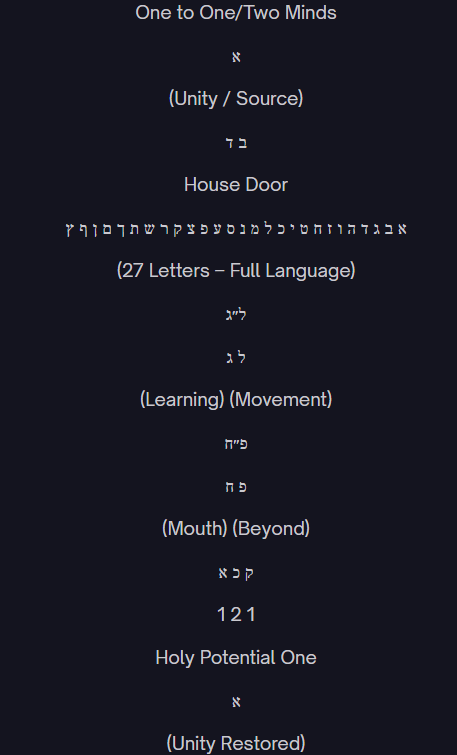
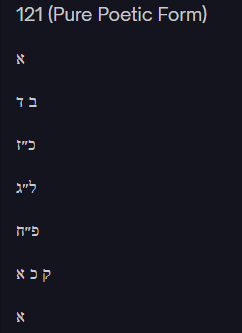
121
The house and door of language
become learning—
rise through illumination,
which through elevated speech
returns to divine unity.

 WoPoLi
Leave a comment