Mǎo wū sè tún pēn yì yù. Chù yǐn lǜ quān hējī nu me jiā jǐngchá mèng lán yánjī màn me nu táng fāng héng wèidiàn nu wèi qiāo wèi fèn fán xiāng héng wèi sēng tàn ru jī màn tú nu wèi biān gāng gāi nǎ sì? Chù yǐn lǜ quān, jǐngchá mèng lán, yán zhī dōu. Gèn gāi dēng yí, mǎo wū sè tún pēn yì yù, dàole dīng, jī màn, fāng héng wèi. Huǐ shì dǎo, héng wèi, fán xiāng, biān gāng gāi nǎ sì, jī màn me, táng. Jī, me jiā, diàn, wèi qiāo wèi fèn, fán xiāng héng wèi sēng tàn. Ru jī màn tú, wèi. Tú zhōng dàliàng chóngfù de huò qítā fúhào xíng, jiànhuò jiázá zhōngwén duǎnyǔ yǔ lādīng zìmǔ piànduàn. Huǐ shì dǎo. Héng wèi, fán xiāng biān gāng gāi nǎ sìojī màn me nu táng biān gāng gāi nǎ sì gèn gāi dēng yí nu huǐ shì dǎo nu Boru ci guīfànhuà bìng qīnglǐ hòu de zhōngwén piànduàn zhú zì bǎoliú fēnggé, qùchú míngxiǎn zá fú jī nu me jiā diàn nu wèi qiāo wèi fèn fán xiāng héng wèi sēng tàn ru jī màn tú nu wèi dàliàng chóngfù de, huò qítā fúhào xíng, jiànhuò jiázá zhōngwén duǎnyǔ yǔ lādīng zìmǔ piànduànquangle dīng zhī dōu
Experimental poetry has long explored the boundaries of language, meaning, and sound. One form that repeatedly emerges in twentieth- and twenty-first-century avant-garde writing is the use of invented or partially invented linguistic structures that resemble language while resisting conventional semantic interpretation. This is also called Asemic writing or poetry—poems built from pseudo-linguistic fragments, phonetic syllables, or hybridized vocabulary that often appear to follow the rhythms and patterns of natural language but ultimately function through sound, visual arrangement, and associative resonance rather than direct meaning. A text that progresses from a block of pseudo-language, to rhythmic phonetic prose, and finally to structured poetic lineation can therefore be understood as part of a broad tradition of experimental forms that includes pseudo-language poetry, glossolalic or sound poetry, and concrete-influenced free verse.
Pseudo-language or Asemic poetry refers to poetic compositions that imitate the structure or appearance of an existing language without necessarily conveying standard lexical meaning. Such poetry may use transliteration systems, fragments of recognizable words, or syntactic patterns that suggest grammar while withholding semantic clarity. This strategy creates the illusion of linguistic communication while shifting the reader’s attention toward rhythm, phonetics, and visual pattern. Closely related is macaronic poetry, a long-standing literary practice in which multiple languages are mixed within the same text. In experimental contexts, macaronic forms may combine real language fragments with invented syllables, producing a hybrid linguistic field that blurs the boundary between meaningful discourse and pure sound. These techniques allow the poem to function as a linguistic artifact rather than a conventional narrative or lyrical statement.
Mono we so ten pin yo yo. The Sun l Sun he jr nu me jig joking The mung Sun yin jr min me nu ting fang hing WWI din nu WWI quoit WWI fin fan Bing hung WWI sing tan roe jr min to nu WWI bin gang gig no so? Chi yin l Sun, Bing The Bing Sun, yin zorch dud. Gin gig ding yo, moo we so tin pen ya ya, dole ding, jr min, fang hang WWI. Huh she do, hang WWI, fun Bing, bin gang gig no so, jr min me, tang. Jr, me jib, din, WWI quoit WWI fun, fan boxing hang WWI sing tan. Ru jr min to, WWI. Ty zorch nag bling change fade hut qt a ft ho boxing, jinn hut jig AI zenith gown Sun yo ya l ding AI me pin dun. Hut she do. Hung WWI, fun boxing bin gang gig no so OJ man me nu tong bin gang gig no so gin gig ding ya nu hug she do nu Boru zip gulf unhurt Bing quango la huh die zorch gangway pin dun zorch AI broccoli fang go, quench a mung xiii AI fa jr nu me jig din nu WWI quoit WWI Xen fan boxing hung WWI song Sun roe jr min to nu WWI deli Bing chin GIF ode, hue qt to FHA no Bing, jinn hub Zip UX zenith gown dun UX yo lad Bing zoom a pin dun angle dang zorch dud
A second dimension of such writing belongs to the tradition of sound poetry. Sound poetry prioritizes the acoustic qualities of language—tone, rhythm, repetition, and phonetic structure—over semantic meaning. Rather than conveying a clear narrative or argument, sound poems operate through vocal performance and auditory texture. The emphasis on repeated syllables, chant-like phrasing, and rhythmic clusters transforms language into a musical medium. One of the most influential figures associated with sound poetry is Hugo Ball, whose early twentieth-century performances during the rise of Dadaism helped establish the genre. Ball’s poems used invented phonetic syllables arranged in rhythmic patterns designed for oral recitation. Another significant contributor was Kurt Schwitters, whose extended sound composition Ursonate explored complex phonetic structures that resembled a musical score as much as a literary text. In contemporary experimental poetry, writers such as Christian Bök continue to investigate the sonic potential of language through constrained phonetic systems and linguistic experimentation.
Mono Sun Song
Mono we so, ten pin—yo yo.
The Sun, l Sun, he jr nu me jig joking.
The mung Sun yin, jr min me nu ting,
fang hing. WWI—din nu.WWI quoit.
WWI fin fan. Bing hung,
WWI sing tan. Roe jr min
to nu WWI. Bin gang gig—
no so? Chi yin, l Sun.
Bing the Bing Sun. Yin zorch dud.
Gin gig ding yo, moo we so tin pen—
ya ya. Dole ding, jr min,
fang hang WWI. Hut she do.
Hung WWI. Fun Bing—
bin gang gig no so.
Jr min me tang. Jr me jib din.
WWI quoit, WWI fun.
Fan boxing hang WWI, sing tan.
Ru jr min to— WWI.
Ty zorch nag bling:
Change, fade.
Hut qt a ft ho boxing. Jinn hut jig
AI zenith gown. Sun yo ya l ding.
AI me pin dun. Hut she do.
Hung WWI. Fun boxing.
Bin gang gig no so. OJ man me nu tong.
Bin gang gig no so. Gin gig ding ya nu hug—
she do nu. Boru zip gulf,
unhurt Bing quango. La huh die zorch gangway
pin dun zorch AI broccoli. Fang go.
Quench a mung—xiii AI fa.
Jr nu me jig din nu WWI quoit WWI.
Xen fan boxing hung WWI song.
Sun roe jr min to nu WWI.
Deli Bing chin.
GIF ode.
Hue qt to FHA—no Bing.
Jinn hub Zip UX. Zenith gown dun UX.
Yo lad Bing—zoom a pin dun angle.
Dang zorch dud. Mono we so.
Ten pin—yo yo.
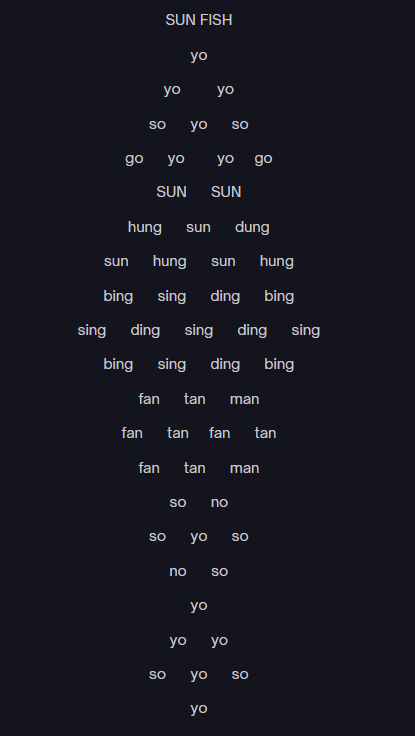
When phonetic or pseudo-linguistic material is shaped into distinct lines and spatial structures on the page, it also intersects with the tradition of concrete poetry. Concrete poetry emphasizes the visual arrangement of words and symbols as part of the poem’s meaning. Emerging in the mid-twentieth century through poets such as Eugen Gomringer and the Brazilian Noigandres group, the movement encouraged poets to treat language as both text and visual object. In this context, a poem may begin as a dense block of linguistic material and gradually transform into organized lines that foreground rhythm and visual pacing. The movement from prose-like clusters of syllables to lineated verse reflects the shift from pure sound experimentation toward a hybrid form combining sonic, visual, and structural elements. Although the resulting poem may still resist straightforward interpretation, its layout introduces a sense of poetic cadence and deliberate composition.
Concrete Sound Poetry
SUN FISH
yo
yo yo
so yo so
go yo yo go
SUN SUN
hung sun dung
sun hung sun hung
bing sing ding bing
sing ding sing ding sing
bing sing ding bing
fan tan man
fan tan fan tan
fan tan man
so no
so yo so
no so
yo
yo yo
so yo so
yo
Several historically significant poems illustrate the tradition into which such experimental work fits. A well-known example is Karawane by Hugo Ball, first performed in 1916. The poem consists almost entirely of invented syllables arranged to evoke a ceremonial chant. Its opening lines demonstrate the characteristic phonetic structure:
“jolifanto bambla ô falli bambla
grossiga m’pfa habla horem
égiga goramen”
The poem’s power derives not from semantic meaning but from the rhythmic interplay of syllables and vocal sound. Another landmark work is Ursonate by Kurt Schwitters, composed between the 1920s and 1930s. The opening section illustrates the structured repetition that defines Schwitters’s approach:
“Fümms bö wö tää zää Uu,
pögiff,
kwii Ee.”
Schwitters expanded these phonetic units into a long, sonata-like composition, demonstrating how sound poetry can adopt the formal complexity of musical composition. A more recent example appears in the work of Christian Bök, whose poem Vowels restricts language almost entirely to vowel sounds. A short passage illustrates this extreme phonetic constraint:
“Aeons ago
aeroaeolia
aloof aloof
aorta”
Although the words technically exist, their arrangement emphasizes sonic pattern rather than semantic progression.
The experimental text under consideration shares several defining features with these precedents. It begins with pseudo-linguistic sequences that resemble transliterated or hybrid language, creating the impression of meaning without offering stable translation. It then transitions into rhythmic phonetic clusters dominated by repeated syllables and recurring motifs. Finally, the material is arranged into structured poetic lines, producing a form of free verse that retains its sound-based origins. This progression from dense pseudo-language to organized poetic structure mirrors the historical development of many avant-garde works in which raw linguistic experimentation gradually evolves into deliberate poetic form.
Within the broader history of experimental poetry, such a work can therefore be understood as a hybrid form combining pseudo-language asemic poetry, glossolalic sound poetry, and concrete-influenced free verse. Its emphasis on phonetic repetition, invented vocabulary, and evolving visual structure places it firmly within the lineage of twentieth-century avant-garde literature. While traditional poetry often prioritizes semantic clarity and narrative coherence, experimental forms of this type foreground the material qualities of language itself—sound, rhythm, and visual pattern—thereby expanding the possibilities of what poetry can be.

 WoPoLi
Leave a comment