Cleave
A cleave poem is a poetic form designed to be read in multiple ways, revealing distinct yet interconnected meanings. The term “cleave” itself embodies a paradox: it means both to split apart and to cling together, perfectly reflecting the essence of this style.
Dual Columns:
The poem is written in two vertical columns, side by side. Each column is a standalone poem when read individually.
Combined Reading:
The two columns can also be read together, line by line, forming a third poem that merges the meanings or themes of the separate columns.
Themes and Tone:
The columns often explore contrasting or complementary ideas, such as light and dark, love and loss, or hope and despair. When combined, they create a nuanced and layered meaning.
Structural Discipline:
Each line must function independently within its respective column while also contributing to the combined reading.
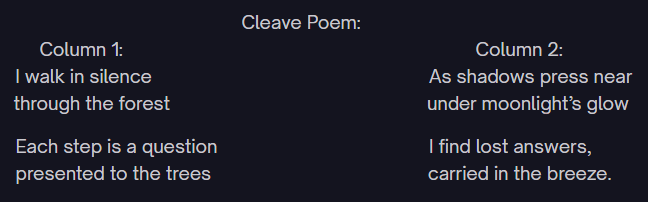
Cleave Poem:
Column 1: Column 2:
I walk in silence As shadows press near
through the forest under moonlight’s glow
Each step is a question I find lost answers,
presented to the trees carried in the breeze.
Combined Reading:
I walk in silence, as shadows press near,
through the forest, under moonlight’s glow.
Each step is a question,
I find lost answers,
presented to the trees, carried in the breeze.
Complexity and Challenge:
Crafting a cleave poem requires skill to ensure all three readings (left column, right column, and combined) are coherent and meaningful.
Richness of Interpretation:
The interplay between the columns and their combined reading creates a layered experience, inviting readers to explore multiple perspectives or emotions.
Creative Expression:
This form offers a unique way to juxtapose or harmonize contrasting ideas, themes, or tones within a single poetic structure.
Cleave poems showcase the flexibility and depth of language, challenging poets to experiment with form, structure, and meaning while offering readers a rich and multifaceted experience.

 WoPoLi
Leave a comment