Language as Meeting: The Kushnir-Inspired Process Behind “All-Language Literature”
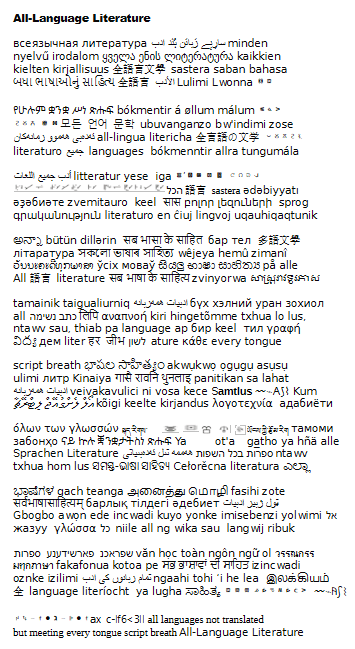
“All-Language Literature” began with a simple act of translation. The title phrase was rendered into many languages and writing systems so that one idea could appear in numerous linguistic forms. In its earliest state, the work resembled a multilingual catalogue: each translation remained complete, distinct, and readable by anyone familiar with that language. Although this arrangement demonstrated linguistic diversity, it still depended on the conventional function of translation. Every phrase repeated the same stable meaning, and each language occupied its own orderly place. The poem became more closely aligned with Pavel Kushnir’s conception of all-language poetry only when those translations were brought into contact, interrupted, fragmented, and combined with symbolic and asemic material.
Kushnir-inspired all-language poetry can be understood as a theory of linguistic liberation. It proposes poetry as a training ground for perceiving meaning before, beneath, or beyond established language. The reader is not asked merely to decode every word or translate every unfamiliar phrase. Instead, the reader is invited to tolerate incomplete comprehension, recognize structures without mastering them, and allow unfamiliar language to become perceptible through contact, rhythm, repetition, and openness. Understanding becomes less an act of possession than an act of participation.
This distinction is important because a poem containing many translations is not automatically an all-language poem in the fullest Kushnir-inspired sense. A conventional multilingual poem may preserve clear separations between languages and offer the reader a dependable original phrase from which every translation can be understood. An all-language poem goes further. It questions the assumption that a language must be completely understood before it can contribute meaning. It allows unfamiliar scripts to remain unfamiliar while still participating in the visual, rhythmic, and conceptual life of the poem.
For this reason, the translations in “All-Language Literature” were not arranged as a clean reference list. They were gathered into a dense multilingual field in which languages meet one another without explanatory labels. Alphabets, syllabaries, abugidas, logographic characters, and right-to-left writing systems occupy the same space. English words appear among Russian, Arabic, Finnish, Chinese, Icelandic, Korean, Armenian, Tamil, Hebrew, and many other forms of writing. The page becomes less like a dictionary and more like a linguistic environment.
The density is intentional. A reader cannot proceed through the poem in the ordinary manner of reading a single sentence from beginning to end. The eye must wander. It may stop on a familiar word, follow the shape of an unfamiliar script, notice the recurrence of “literature” or “language,” or move between visual clusters without knowing their literal meanings. The poem therefore changes reading from a linear act into an exploratory one. Each reader creates an individual route through recognition, uncertainty, return, and discovery.
The use of many Unicode-supported scripts made this meeting possible in a digital document. Unicode itself is not a language or a poetic form. It is the encoding system that permits numerous writing systems to coexist on the same page. In the poem, however, that technological capacity becomes artistically significant. Scripts that might once have required separate printing systems, fonts, or typesetting methods can now appear beside one another within a continuous composition. The digital page becomes a shared territory in which no writing system must remain isolated.
The poem does not claim literally to contain every language. Such completeness would be impossible. “All-language” instead expresses an inclusive poetic aspiration. The poem creates a conceptual space in which all languages are welcomed, even though only a selection can physically appear. The title refers less to a census of world languages than to a rejection of linguistic exclusion. No single language is presented as the natural owner of literature, meaning, or poetic expression.
English introduces the work through the title “All-Language Literature,” but English does not remain completely dominant. Inside the poem, it becomes one language among many. Familiar English fragments such as “literature,” “language,” “every tongue,” “script,” and “breath” appear within the multilingual field rather than outside it as translations or instructions. These words provide temporary points of orientation, but they do not explain the entire composition. The reader is given enough familiarity to continue without being allowed to reduce every other language to English.
The fragmentation of the translations was another important stage in the poem’s development. Complete phrases were retained because the work needed to remain connected to actual languages and meanings. At the same time, some words and phrases were separated, interrupted, or placed beside fragments from unrelated languages. This produced a tension between legibility and uncertainty. A reader may understand one phrase, lose that understanding in the next cluster, and then encounter another recognizable word several lines later.
The purpose of fragmentation was not simply to make the poem unreadable. If every word had been chopped into isolated characters, the differences among the languages might have disappeared into undifferentiated visual noise. The poem instead preserves a balance among complete translation, partial phrase, broken syntax, symbolic interruption, and renewed comprehension. The reader repeatedly moves toward meaning and away from it.
This procedure connects “All-Language Literature” with the cut-up technique. Cut-up writing uses existing language as material. Words, phrases, or sections are removed from their original arrangements and placed into new relationships. The resulting work is not merely a quotation of the source material. Meaning changes because the order, boundaries, and surrounding context have changed.
The related poem “Cut Up Online Dictionary” demonstrates this process in a particularly direct form. It begins with dictionary definitions, but it interrupts those definitions at selected words. The final word or idea from one fragment then becomes the entry that begins the next fragment:
Cut: to penetrate with or as if with an edged
Instrument: device used to produce
Music: vocal, instrumental, or mechanical
Sound: a particular
Auditory: of, relating to, or experienced
Through: by way
Of: relating
To:
The sequence moves through “cut,” “instrument,” “music,” “sound,” “auditory,” “through,” “of,” and “to.” These entries were not written as one continuous passage in the dictionary. They become a poem because the definitions have been cut, truncated, and linked. Each incomplete definition pushes the reader into the next word before the previous thought has been resolved.
The second section performs a similar movement:
Up: into a higher position or
Level: horizontal
Condition: an environmental
Requirement:
Necessity: the quality or state of being in
Need:
Necessary:
Essential: something
Necessary: See Prior Definition of Necessary
Here the chain moves through “up,” “level,” “condition,” “requirement,” “necessity,” “need,” “necessary,” and “essential” before returning to “necessary.” The poem reveals the circular structure of dictionary language. A word is defined through another word, which requires another definition, which may eventually return the reader to the place where the search began. The promise of a final, self-contained meaning is never completely fulfilled.
“Cut Up Online Dictionary” is therefore a recursive lexicographic cut-up. Its method is systematic rather than entirely random. The source is the dictionary, the cutting points are selected, and each terminal word becomes a bridge to a new entry. The poem qualifies as cut-up because it extracts, interrupts, displaces, and recombines preexisting language. Its new meaning does not exist in any individual dictionary entry but emerges through the constructed sequence.
Its subject and method also mirror one another. The poem begins by defining “cut” and “up” while physically and syntactically cutting up the definitions of those words. It does not merely discuss the cut-up technique; it performs it. The unfinished phrases become evidence of the act named by the title.
This method informed the construction of “All-Language Literature.” The multilingual phrases were treated not only as translations to be displayed but as textual material that could be repositioned and brought into new relationships. Words from different languages were allowed to touch without being grammatically joined. Fragments could interrupt one another. A phrase moving from right to left could appear inside a field dominated by left-to-right movement. A recognizable English word could emerge inside an unfamiliar script and then disappear again.
The cut-up method is therefore not present only because the poem contains broken lines. Lineation alone does not create a cut-up. The method is present because language has been removed from its original context, divided at deliberate points, and recombined so that new relationships appear. The translations no longer function solely as independent equivalents of one English title. Together they form a new composition whose meaning depends on their collision and proximity.
The symbolic sequence near the bottom of “All-Language Literature” carries the poem beyond multilingual translation and toward asemic writing. Asemic writing resembles language but does not provide a fixed verbal statement that can be conventionally translated. It may suggest handwriting, notation, code, ornament, or an unknown alphabet while leaving its meaning open.
The symbols in the poem create a threshold between readable and unreadable language. Some are recognizable as existing marks, mathematical signs, decorative forms, or encoded characters, while their combination resists ordinary interpretation. They are not intended to hide a secret sentence. Their purpose is to preserve the appearance and motion of communication after stable lexical meaning has begun to dissolve.
This symbolic field contributes to the poem’s central experience. The reader has already crossed many languages that may not be understood. The asemic or near-asemic material then removes even the certainty that the marks belong to a readable linguistic system. The reader must respond to spacing, recurrence, shape, direction, and rhythm. The poem asks whether language can still be encountered when translation is no longer available.
The symbolic passage also prepares the return to recognizable English at the conclusion:
all languages not translated
but meeting every tongue script breath
This statement serves as the interpretive key to the entire work. The poem’s purpose is not to translate every language into one dominant language. It is to allow languages to meet while preserving their differences. Translation remains part of the poem’s origin, but meeting becomes its final principle.
The word “meeting” is especially important. Translation can create understanding, but it can also suggest that an unfamiliar language becomes meaningful only after it has been converted into a familiar one. In “All-Language Literature,” languages are permitted to remain visibly themselves. Their scripts, forms, textures, and rhythms contribute to the poem even when a reader cannot explain their literal content.
The concluding words “tongue,” “script,” and “breath” expand the poem beyond printed vocabulary. “Tongue” suggests spoken language and the physical act of speech. “Script” identifies the visual body of language. “Breath” evokes the living human presence beneath writing and sound. Language is therefore presented not simply as a collection of dictionary definitions but as a human activity involving body, culture, memory, movement, and voice.
The repetition of “All-Language Literature” at the end creates a frame around the composition. At the beginning, the phrase functions as a title and a proposition. The reader has not yet experienced what all-language literature might mean. At the end, the same words return after the reader has moved through translation, multilingual density, fragmentation, cut-up, symbolic interruption, and partial recovery. The title has become something the poem has enacted.
The creative process therefore moved from translation to transformation. Complete translations supplied the original linguistic material. Unicode-supported scripts allowed those languages to coexist visually. Cut-up procedures disrupted their separation and produced new relationships. Asemic and symbolic marks pushed communication beyond direct lexical meaning. The final English statement restored a degree of clarity without explaining or controlling everything that came before it.
The apparent disorder of “All-Language Literature” is consequently structured. The poem progresses from an identifiable title into a field of languages, from linguistic recognition into fragmentation, from fragmentation into symbolic uncertainty, and from uncertainty into a final statement of meeting. Its form asks the reader to experience the idea rather than merely read an explanation of it.
As a Kushnir-inspired work, the poem does not demand mastery. It permits the reader to know some languages, recognize others, misunderstand many, and still participate. Meaning is formed not only by what can be translated but by the relationships among words, scripts, fragments, symbols, spaces, and acts of attention. The poem proposes that unfamiliarity need not be a barrier to poetic experience.
“All-Language Literature” is therefore both a multilingual visual poem and an experiment in linguistic freedom. Its languages are not presented as specimens in separate containers. They enter a common field, interrupt one another, survive fragmentation, pass through the edge of asemic expression, and emerge in the declaration that they are “not translated but meeting.” In that meeting, understanding is no longer possession. It is presence, contact, and participation.
Cut Up Online Dictionary
Cut: to penetrate with or as if with an edged
Instrument: device used to produce
Music: vocal, instrumental, or mechanical
Sound: a particular
Auditory: of, relating to, or experienced
Through: by way
Of: relating
To:
Before: forward
Of: See Prior Definition of Of.
Up: into a higher position or
Level: horizontal
Condition: an environmental
Requirement:
Necessity: the quality or state of being in
Need:
Necessary:
Essential: something
Necessary: See Prior Definition of Necessary


Leave a Reply