The Process and Reasoning Behind “All-Language Literature”
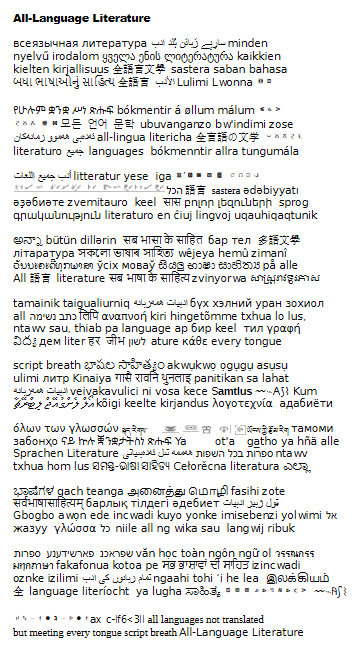
“All-Language Literature” began as a gathering of translations. The phrase at the center of the poem was rendered in many languages and scripts so that a single idea could appear through numerous linguistic forms. At first, the translations could have been arranged as a conventional list, with each language kept separate and treated as another version of the same statement. That approach would have demonstrated linguistic variety, but it would still have asked the reader to understand the work through an orderly system of translation. The finished poem moves beyond that arrangement. It does not simply display different languages; it allows them to meet, overlap, interrupt, and transform one another.
The poem was influenced by Pavel Kushnir’s theory of all-language poetry as a form of linguistic liberation. In this theory, poetry becomes a place where readers can encounter language without being required to master or completely decode it. The unfamiliar word is not presented as a problem that must immediately be solved. Instead, it can be experienced through its visual form, position, rhythm, repetition, and relationship to the words surrounding it. The reader may recognize certain languages while remaining unable to interpret others, yet this incomplete understanding does not exclude the reader from the poem. Partial recognition becomes part of the reading experience.
For this reason, the translations were not kept in clearly labeled rows. They were brought together into a dense multilingual field. Words written from left to right encounter words written from right to left. Alphabetic writing appears beside syllabic, abugida, logographic, and other writing systems. Familiar English fragments emerge and then disappear among scripts that many English-speaking readers may not recognize. This arrangement prevents any one language from becoming the unquestioned center of the composition. English introduces the title, but it does not control the entire body of the poem. It becomes one participant among many.
The density of the page is deliberate. The poem initially appears almost overwhelming because the reader cannot proceed through it in the ordinary manner of reading one sentence after another. The eye must wander. It may pause on a recognizable phrase, move toward a striking character, follow a repeated word, or notice the contrast between different writing systems. Reading becomes less linear and more exploratory. The reader does not receive a single prescribed route through the poem but creates a path through acts of recognition, uncertainty, curiosity, and return.
The multilingual material was also fragmented and interwoven rather than merely reproduced. Complete translations remain in the poem so that the work retains contact with actual language and meaning. Around them, however, words and phrases from different languages are placed in immediate proximity. English words such as “literature,” “language,” “every tongue,” “script,” and “breath” appear inside the broader field rather than outside it as explanations. These recurring English fragments act as temporary points of orientation, but they never translate the entire poem. They allow meaning to surface without reducing every unfamiliar expression to an English equivalent.
This balance between complete language and fragmentation is important. The purpose was not to make the poem entirely unreadable. If every word had been broken apart, the linguistic diversity could have collapsed into undifferentiated visual noise. Instead, the poem moves repeatedly between recognition and uncertainty. A reader may understand one phrase, lose certainty in the next, and then encounter a familiar word several lines later. Meaning is neither completely available nor completely absent. It exists in motion.
Unicode-supported scripts made it possible to place a large range of written languages within the same digital composition. This technological aspect is part of the poem’s construction, but Unicode itself is not treated as a language. It is the means through which scripts that were once difficult to reproduce together can now share the same page. The resulting visual field suggests a world in which languages do not have to remain separated by national, typographic, or technological boundaries.
The sequence of unusual symbols near the conclusion pushes the poem toward asemic writing. These marks resemble pieces of language, notation, decoration, or code, but they do not form a statement that can be translated in the ordinary way. Their purpose is not to conceal a secret sentence. They create a region where the appearance of communication remains even as definite verbal meaning becomes unstable. The reader is invited to respond to rhythm, shape, repetition, spacing, and visual suggestion. This passage continues the poem’s movement away from language as something that must be possessed through complete comprehension.
The symbols also function as a threshold. They appear near the point where the poem begins to emerge from multilingual density into its final statement. After encountering many languages and then passing through signs that resist translation, the reader reaches the words “all languages not translated but meeting every tongue script breath.” This line explains the central reasoning behind the composition. The poem does not seek to translate every language into one dominant language. Its purpose is to let languages meet without requiring them to surrender their differences.
The word “meeting” is therefore more important than “translation.” Translation can build understanding, but it can also imply that an unfamiliar language becomes meaningful only after it has been converted into a familiar one. In this poem, languages are permitted to remain visibly themselves. Their scripts, rhythms, and forms contribute to the work even when the reader cannot interpret their literal content. The reader participates by remaining present before what is unfamiliar rather than immediately demanding that it become familiar.
The words “tongue,” “script,” and “breath” extend the poem beyond printed vocabulary. “Tongue” suggests spoken language and the physical act of speech. “Script” recognizes the visible body of writing. “Breath” points toward the living human presence beneath both speech and text. Together, these words suggest that language is not merely a system of definitions. It is sound, shape, movement, culture, memory, and human expression.
The title appears again at the end, creating a frame. At the beginning, “All-Language Literature” names an idea that the reader has not yet experienced. At the conclusion, the same phrase returns after the reader has crossed the multilingual and asemic field. It no longer functions only as a title. It becomes a statement about the kind of literature the poem has attempted to create: literature in which languages coexist without being arranged according to a hierarchy of familiarity.
The process of creating “All-Language Literature” therefore moved from translation to encounter. It began with one phrase repeated in many languages, but it developed into a visual and linguistic composition concerned with how readers respond when complete comprehension is impossible. Its apparent disorder is structured around a deliberate progression from recognizable language, through intermixture and uncertainty, toward symbolic writing and a final moment of renewed clarity.
The poem does not claim to contain every language in existence. “All-language” expresses an inclusive aspiration rather than a literal census. The work invites every language into the conceptual space of the poem while acknowledging that no individual reader can possess them all. Its central act is not mastery but participation. The reader is asked to look, listen inwardly, recognize what is possible, tolerate what remains unknown, and experience language as a meeting rather than a border.


Leave a Reply