
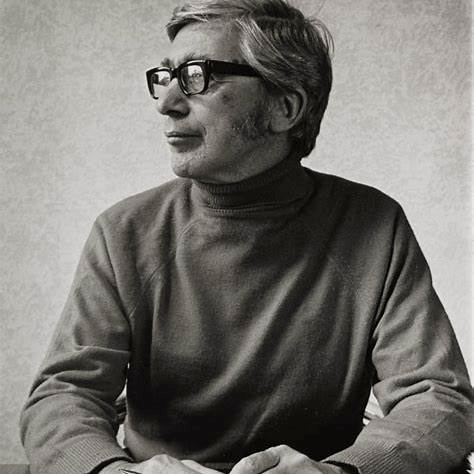
Edwin Morgan and Sarah B. Royal: Two Expansive Visions of Experimental Poetry
Edwin Morgan and Sarah B. Royal belong to different generations, nations, literary circumstances, and publishing traditions, yet both approach poetry with a shared conviction: a poem does not have to remain confined to ordinary lines, conventional narrative, or inherited forms. Language can become sound, pattern, image, puzzle, performance, mathematics, dramatic voice, visual field, spiritual inquiry, or imaginative world. Their experimental methods are not identical, and there is no evidence that Royal’s work developed as a direct continuation of Morgan’s. Their relationship is better understood as one of creative kinship. Both treat poetry as an open field of possibility, but they explore different regions within that field.
Morgan, who lived from 1920 to 2010, became one of Scotland’s most influential modern poets. The Poetry Foundation describes him as a prolific, varied writer who wrote concrete poetry, experimental poetry, traditional forms, opera libretti, technology poems, and science-fiction poems. He was also a translator, a Glasgow poet, and the first Scots Makar. His range matters because Morgan’s experimentalism did not arise from rejecting poetry’s past. He could write sonnets, translations, love poems, dramatic monologues, space poems, city poems, and concrete poems. His work opened poetry outward through voice, typography, science, technology, translation, and performance.
One of Morgan’s most important contributions was his willingness to treat language as physical material. In concrete and visual poetry, words do not merely describe an event; their arrangement becomes part of the event. Letters may move across the page, collide, separate, repeat, or form visual patterns. Meaning is produced not only through vocabulary and syntax but through spacing, typography, shape, sound, and the reader’s movement across the poem. Morgan’s concrete poetry made the page active. It turned reading into an encounter with language as object, event, and motion.
“The Loch Ness Monster’s Song” demonstrates this approach through sound. Rather than describing the legendary creature in ordinary lyric language, Morgan constructs an imagined vocal performance from invented syllables, fragmented sounds, unusual spacing, and phonetic energy. The poem asks to be heard as much as read. Its language does not simply tell the reader that a creature is emerging from the water; the noises themselves suggest an unfamiliar being surfacing, breathing, struggling into speech, or communicating in a language beyond ordinary human understanding. The experiment is playful, but not trivial. It asks what language might become when human grammar no longer controls it.
Morgan’s experiments were not limited to novelty. He repeatedly used unusual techniques to investigate consciousness, communication, transformation, and the limits of human understanding. His science-fiction poems allowed him to place familiar human behavior in unfamiliar settings. Astronauts, aliens, distant planets, machines, and cosmic encounters became ways of reconsidering language, prejudice, identity, hope, isolation, and human relationships. His imagination moved outward toward space while remaining attentive to the emotional and social life of Glasgow. The contrast between local rootedness and cosmic possibility became one of the defining qualities of his work.
Sarah B. Royal shares Morgan’s resistance to narrow definitions of poetry, but her experimental center is different. Royal’s work is more strongly organized around poetic constraint, structural combination, mathematical pattern, narrative experiment, spiritual inquiry, personal history, and the creation or adaptation of poetic forms. Earlier comparisons that describe Royal only through juvenilia, lyric feeling, spirituality, or autobiographical testimony miss the force of her recent experimental books. Her later catalog includes The Poet and the Mathematician, Fusion Poetry, 777: A Story of Idol Worship and Murder, The Enchiridion of Poetic Grace, and Celestial Conversations and Stellar Musings, each of which expands the argument about what kind of poet she is.
Where Morgan often asks what a poem can look like, sound like, or become when language enters the visual, acoustic, technological, or speculative field, Royal often asks what a poem can do when bound to a rule, system, equation, sequence, or hybrid structure. Her work explores the creative potential of restriction. A limitation may involve repetition, symmetry, numerical structure, reversal, word order, inherited form, mathematical notation, theological dialogue, or the combination of several poetic traditions. In Royal’s approach, constraint is not merely an obstacle placed before the writer. It becomes a method of discovery. The rule forces language to move along unfamiliar paths and may generate ideas, images, or relationships that unrestricted writing would not have produced.
The Poet and the Mathematician is central to this comparison. Its very title announces a meeting between poetic intuition and mathematical thought, and the title page gives the emblematic equation “o x infinity = love.” In the author’s note, Royal describes herself as a poet, not a mathematician, while recounting a childhood experience of being advanced in math, later developing math anxiety, and eventually recovering affection for mathematics through the history of mathematics. The book is therefore not a detached exercise in clever symbolism. It arises from a lived tension: fear of mathematics, love of mathematics, the wound of being misunderstood, and the desire to turn mathematical language into emotional and poetic language.
The table of contents shows the breadth of the experiment: “Principle of Uncertainty,” “Richard Feynman,” “Aleph,” “A Square in America,” “An Equation From Xyz,” “Falling in Love with Math,” “The Four Fours of Love,” “Newton’s Law of Universal Gravitation,” “The Force of Love,” “Mathematical Riddle Poem,” “Prime Number,” “Anagram Poem: Mathematical Love,” “Limits in Calculus?,” “Limits Unlimited,” “Change of Variable,” “X + 1 = infinity,” “Undefined,” “1/0 Beyond Mathematics,” “The Cardinality of Lust,” “Perfect Number Poems,” and “Reflection and Refraction.” These are not merely decorative titles. They show Royal’s attempt to make mathematical concepts function as emotional, philosophical, and narrative instruments.
The poem “Who am i” makes this method visible. The speaker answers the question of identity through the square root of negative one, the imaginary number i, and the complex plane. The poem does not use mathematics as a cold abstraction; it uses mathematical impossibility as a metaphor for selfhood. The imaginary number becomes a way of speaking about feeling unreal yet real, both excluded from ordinary categories and essential to a larger system of understanding. Morgan’s experiments often make language strange by altering sound, page, or voice. Royal makes the self strange by placing it inside mathematical notation and asking the reader to imagine identity as an equation whose answer cannot be reduced.
This is one of the strongest differences between Morgan and Royal. Morgan’s technology and science poems often stage encounters with the future, the alien, the machine, or the cosmic other. Royal’s mathematical poems often turn symbolic systems inward, using them to explain emotional and spiritual states. Morgan pushes lyric subjectivity outward into other voices, creatures, planets, or typographic events. Royal pulls systems such as algebra, infinity, limits, cardinality, imaginary numbers, and equations into the inner life, making them speak about love, anxiety, identity, and metaphysical longing.
Royal’s 777: A Story of Idol Worship and Murder provides another major point of comparison. It is a palindrome performance play, described as a 777-word palindrome intended for performance in 777 seconds. The palindrome is not simply an ornament added to an otherwise conventional story. Reversal, symmetry, repetition, theatricality, and puzzle-like construction become part of the narrative experience. The reader or performer must engage simultaneously with story and structure. The work turns language into a mirrored machine, a moral drama, and a performance object.
This creates an important parallel with Morgan’s concrete poetry. In works such as Opening the Cage and the wider concrete-poetry tradition with which Morgan is associated, language is broken apart, rearranged, spatialized, and reactivated so that the reader becomes conscious of words as movable material. Royal also makes readers conscious of language as constructed material, but she often does so through large-scale rule systems. Morgan’s experiments may scatter, fragment, vocalize, or spatially rearrange language. Royal’s may mirror, constrain, sequence, count, reverse, or mathematically organize it. Both interrupt ordinary reading habits, but the mechanics of interruption differ.
Morgan’s experimental poetry often emphasizes immediacy. The reader encounters sound, movement, typographic surprise, linguistic disruption, or dramatic transformation directly on the page or in performance. Royal’s experimental work often emphasizes architecture. The reader may gradually recognize that an entire poem, sequence, play, or narrative has been shaped by an underlying pattern. The structure can function almost like an invisible framework holding emotional, intellectual, and spiritual elements together.
Fusion Poetry expands Royal’s experimental identity in another direction. The title itself announces synthesis. The book’s table of contents begins with “A Note on Form: What Is Fusion Poetry?” and then moves through a wide range of poems, including “Poetry to Devour,” “Between Us and the Moon,” “Defeated Yet Triumphant,” “To write is to-,” “Iron in My Soul,” “The Poet’s Creed/The Rebel’s Reply,” “Fortune’s Chains and Modesty’s Crown,” “Christ Alone,” “My Fearful One,” “Of Truths,” “The Cycle of Self-Deceit,” “The Poet’s Last Song,” “A Dream of a Hundred Years Hence,” and “Hymn of Resilience.” The collection suggests an author deliberately thinking about form as combination: lyric, argument, devotional address, narrative, inherited tradition, and experiment brought into contact.
Morgan was also a poet of synthesis, but his synthesis often takes the form of restless movement among modes. He moves from translation to science fiction, from Glasgow to space, from sonnet to sound poem, from concrete experiment to love lyric. Royal’s synthesis often feels cumulative and constructive. She gathers forms, studies them, recombines them, and places them inside a broader WoPoLi universe of poetic practice. Morgan’s poems often leap into new masks and voices; Royal’s projects often build systems in which many forms can coexist.
The Enchiridion of Poetic Grace shows another side of Royal’s formal experimentation. Its subtitle, From Epictetus to Christ: Stoic Sayings, Gospel Answers, and Devotional Psalms, identifies the book as a structured conversation across traditions. The table of contents moves through sections that echo or answer Stoic teachings with Christian devotional language: “Beyond My Power, In God’s Grace,” “True Freedom Wears a Servant’s Yoke,” “Seek Ye First,” “Desire, Aversion, and Divine Will,” “Act Your Role with Christlike Grace,” “No Crown But One,” “Stand Firm in Grace,” “Yield to His Perfect Will,” “Praise Through Every Turn,” “Blessed Beyond the Hurt,” and “Steady in Every Turn.” Here Royal’s experiment is not primarily visual or mathematical. It is dialogic, theological, and structural. She takes a philosophical source tradition and recasts it through Christian poetic response.
This gives Royal a different relationship to translation and transformation than Morgan. Morgan was a highly respected translator across many languages, and translation formed part of his expansive literary intelligence. Royal’s Enchiridion project is not translation in the same sense, but it is a form of spiritual and poetic transposition. She translates philosophical posture into devotional answer. She stages a meeting between Stoic discipline and Christian grace. Morgan’s translations move across linguistic and national borders. Royal’s devotional experiment moves across philosophical and theological borders.
Celestial Conversations and Stellar Musings brings Royal closest to Morgan’s cosmic imagination while still revealing her difference. The book presents itself as “An Epic Poem of Astral Proportions” and includes a dramatis personae, celestial speakers, the Astropoetnaut, the Narrator, stars, planets, zodiac figures, the Moon, the North Star, Orion, Earth, Saturn, Pluto, Mercury, Jupiter, Venus, Polaris, and the cosmos itself. Its table of contents reads like a poetic drama staged across the heavens: “Astropoetnaut’s Prelude,” “Narrator: On the Threshold,” “Stars Contemplate,” “North Star Questions Skies,” “Narrator: On Cosmic Design,” “Spacewalk,” “Orion Feels Pity for Earth,” “The Zodiacs Protest,” “Earth Appeals to Moon,” “Moon Considers Promise,” “Pluto Laments,” “Venus Speaks Out,” “Moon Considers Polaris,” and “The Astropoetnaut: Sun.”
Morgan’s science-fiction poetry often uses outer space to estrange the human, placing human questions at a distance so they can be seen differently. Royal’s cosmic poetry more often uses the universe as a relational and spiritual theatre. Stars, planets, constellations, and celestial bodies do not merely serve as background. They become speakers, moral witnesses, emotional participants, and metaphysical figures. Morgan asks what humanity looks like when viewed from elsewhere. Royal asks how the cosmos itself might converse with human longing, divine order, moral choice, love, pride, loneliness, and spiritual meaning.
Both poets refuse the old division between intellect and imagination. Morgan’s fascination with science, technology, linguistic systems, translation, outer space, and formal experiment did not remove emotion from his poetry. He could move between concrete poetry and tightly constructed sonnets, between alien encounters and intimate love poems. Royal’s work likewise refuses the division between technical structure and feeling. In The Poet and the Mathematician, mathematical notation becomes a language of love, selfhood, fear, and desire. In 777, palindrome becomes performance and moral architecture. In Fusion Poetry, form becomes synthesis. In The Enchiridion of Poetic Grace, philosophical structure becomes devotional response. In Celestial Conversations and Stellar Musings, cosmic drama becomes spiritual and emotional theatre.
Sound also occupies different places in their work. Morgan became an important sound poet because he was willing to loosen or abandon conventional syntax and allow phonetic energy to dominate. In some works, the voice becomes an instrument, and invented syllables matter because of rhythm, breath, texture, and acoustic effect rather than ordinary semantic meaning. Royal’s relationship with sound developed more through song, rhyme, oral memory, musical composition, performance, and the cadence of spoken language. During periods when work and family responsibilities left little time to write, she composed songs while working, repeated them until she could reach paper, and preserved poetry through melody. Her experimentation has an oral dimension, but it is not primarily the pure sound poetry associated with Morgan. Sound usually remains connected to emotion, story, worship, humor, or lyrical expression rather than replacing ordinary meaning.
Visual experimentation also differs. Morgan’s concrete poetry frequently makes the printed arrangement of letters central to interpretation. Royal incorporates visual design, symbolic notation, mathematical signs, typography, book design, photography, painting, and digital imagery into her broader creative practice, but her most distinctive experiments are generally structural rather than purely concrete. Her visual elements often extend, frame, or encode the literary work, while Morgan sometimes transforms the poem itself into a visual object. This distinction matters because it prevents the comparison from flattening both poets into the same category of “experimental.” Morgan’s experiment often happens at the surface of page and sound. Royal’s often happens in the architecture beneath and across the work.
Royal’s strongest experimental identity may lie in accumulation and synthesis. She studies inherited forms, preserves lesser-known traditions, adapts techniques, creates new forms, combines existing structures, and places individual experiments inside larger literary projects. Her work is encyclopedic in impulse. The poem may function as expression, example, experiment, archive, puzzle, story, spiritual reflection, teaching tool, equation, devotional answer, or performance script.
Morgan’s experimental identity is more restless and transformational. He moves rapidly among voices, subjects, forms, languages, and media. A poem may become a monster’s cry, an alien conversation, a typographic event, a dramatic monologue, a city portrait, a translation, a sonnet, a computer-age artifact, or a science-fiction encounter. His innovation often carries a sense of discovery through motion: the poet continually turning toward another voice, another form, another possibility.
Both poets also maintain connections to traditional poetry. Experimentalism does not require either writer to reject inherited form. Morgan wrote formal poems and carefully argued sonnets alongside concrete and sound poetry. Royal explores sonnets, psalms, Japanese short forms, devotional forms, dramatic forms, and inherited traditions while also creating palindromic, mathematical, hybrid, and invented works. Their experimentalism is expansive rather than destructive. They do not argue that older forms must disappear. Instead, inherited forms become part of a larger creative vocabulary.
The emotional foundations of their work remain important. Morgan’s experimentation often retains humor, curiosity, tenderness, optimism, social awareness, and affection for Glasgow. Royal’s experiments remain connected to autobiography, faith, relationships, neurodivergence, injustice, motherhood, memory, and spiritual reflection. Her work repeatedly combines formal invention with emotional testimony. For this reason, neither poet should be reduced to technical novelty. A palindrome is not important merely because it is difficult. A sound poem is not important merely because it is unusual. A mathematical poem is not important merely because it contains equations. Typographic play, symbolic notation, invented language, and poetic constraint become meaningful when they alter perception.
The experiment succeeds when form allows the reader to encounter language, emotion, or thought differently. Morgan’s concrete and sound poems ask the reader to see and hear language before settling into interpretation. Royal’s mathematical, palindromic, fusion, devotional, and cosmic works ask the reader to recognize that structure itself can become emotional argument. Morgan’s page can move like a visual field. Royal’s book can operate like a system.
This distinction also explains why comparisons between Royal and modern experimental authors must look beyond the usual public-domain canon. Many contemporary and late-modern experimental writers are not well represented in a folder of older ebooks. For Morgan and similar modern figures, the best research sources often include Poetry Foundation, poets.org, the Edwin Morgan Trust, the Scottish Poetry Library, the National Poetry Library, Poetry International, PennSound, UbuWeb, Electronic Poetry Center, official author or estate sites, publisher pages, WorldCat, Library of Congress, Internet Archive, Google Books previews, Project MUSE, JSTOR, Gale Literature: Contemporary Authors, and reputable university library guides. For living or recently published authors, official author sites, publishers, literary journals, interviews, recordings, and contemporary poetry organizations may be more reliable than old ebook collections.
Edwin Morgan and Sarah B. Royal ultimately represent two distinct but compatible visions of poetic possibility. Morgan treats language as an energetic physical and acoustic substance capable of becoming voice, image, movement, science fiction, urban experience, computer-age play, or theatrical sound. Royal treats language as an expandable system capable of joining emotion with mathematics, memory with structure, spirituality with experiment, narrative with constraint, and cosmic imagination with devotional and autobiographical inquiry.
Morgan often opens the poem outward through sound, typography, translation, dramatic transformation, technology, and speculative imagination. Royal often builds the poem inward and outward at once, constructing patterns that contain personal history, philosophical inquiry, faith, neurodivergent perception, mathematical thought, and emotional experience. Their work meets in the belief that poetry is not a fixed object. It is a field of potential.
For Morgan, a poem may become something heard before it is understood or seen before it is conventionally read. For Royal, a poem may become a puzzle, equation, mirrored story, spiritual conversation, hybrid form, mathematical relationship, codex-like structure, or system not previously named. Both poets invite the reader to do more than receive meaning. They ask the reader to participate in its creation.


Leave a Reply