
THE LANGUAGE OF CHANGE
Theme: How identity changes through relationships.
This variation is a true two-direction grammatical matrix. Every horizontal line and every vertical column forms a sentence. Below are artistic choices for varied presentation of the material.
we
who
change
still
remains
who
we
change
still
remains
change
change
changes
change
changes
still
still
change
still
remains
remains
remains
changes
remains
remains
Read across or down. The matrix is symmetrical, so the same sequences emerge in either direction.
This is a more radical experiment in lexical self-reference. It deliberately sacrifices some conventional grammar for a structure in which the words change, and constantly redefine one another.
Its central paradox is that remaining and changing are not necessarily opposites. The poem’s symmetrical construction enacts the idea that identity can survive transformation.
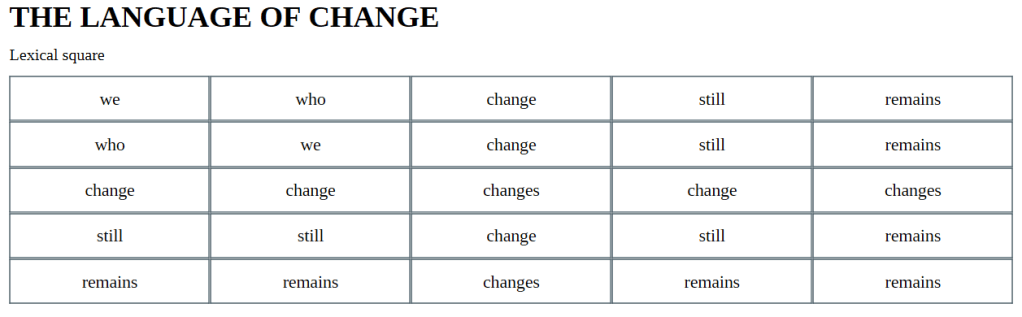
we · who · change · still · remains
who · we · change · still · remains
change · change · changes · change · changes
still · still · change · still · remains
remains · remains · changes · remains · remains
we · who · change · still · remains
who · we · change · still · remains
change · change · changes · change · changes
still · still · change · still · remains
remains · remains · changes · remains · remains
Reading paths
Hinge: (off)
Row 1
we · who · change · still · remains
Row 2
who · we · change · still · remains
Row 3
change · change · changes · change · changes
Row 4
still · still · change · still · remains
Row 5
remains · remains · changes · remains · remains
Column 1
we · who · change · still · remains
Column 2
who · we · change · still · remains
Column 3
change · change · changes · change · changes
Column 4
still · still · change · still · remains
Column 5
remains · remains · changes · remains · remains
Diagonal ↘
we · we · changes · still · remains
Diagonal ↙
remains · still · changes · still · remains
Author notes
Identity through relationships. Symmetrical experimental matrix; coherence and grammar are author judgments.


Leave a Reply